
1. Why distance MBA is still a conversation in 2026
Every year, a large number of people search for distance MBA in programmes. Not online MBA — distance MBA, specifically. They want to know which universities offer it, what it costs, whether it will be accepted by employers, and whether the effort and money are worth spending. This is why Distance MBA in India 2026 continues to attract students looking for affordable and flexible management education.

In 2026, that search continues, even as online MBA -distance MBA in India 2026 has grown substantially and received more attention. Distance education has not disappeared. It has evolved, been formalised under the UGC-DEB regulatory framework, and continues to serve a specific population for whom it remains the most practical option available. As demand grows, Distance MBA in India 2026 has become one of the most searched and practical MBA options in India.
The confusion between distance and online MBA is genuine and widespread. Search results, college websites, and advice forums frequently use the terms interchangeably, which they are not. An online MBA involves structured digital delivery — live video sessions, an active learning management system, peer interaction in cohorts, and proctored online assessments. Understanding Distance MBA in India 2026 is important if you want to make the right decision about your management career.
A distance MBA involves primarily self-study through printed or PDF study material, term-end examinations at designated centres, limited faculty interaction, and a learning experience that is largely solitary. They are different models with different levels of academic engagement, different price points, and different employer perceptions. This is why Distance MBA in India 2026 is gaining popularity among students and working professionals across India.
In 2026, the distance MBA’s continued relevance is anchored in three realities. First, it is the most affordable form of MBA education in India — full programmes at Rs 15,000 to Rs 60,000 total from government open universities. For candidates in financially constrained situations, there is no cheaper path to a recognised master’s degree in management. Second, it is the most geographically accessible form — no reliable broadband, no requirement for a device capable of video streaming, no need to travel to any campus.
A student in a remote rural area with intermittent connectivity can complete a distance MBA through study materials and local exam centres. Third, for government job promotions and qualification upgrades, a UGC-DEB recognised distance MBA degree is legally equivalent to any other MBA — the employment departments that process these credentials do not distinguish by mode.
The question this guide addresses is not whether Distance MBA in India 2026 exists or is used. It clearly does and is. The question is who it is right for, which institutions are credible, what the actual career impact is, and how to distinguish a recognised programme from the many distance MBA offerings that operate without proper authorisation. Distance MBA in India in 2026 is a legitimate option for a specific profile of candidate. Understanding that profile — and whether you fit it — is the starting point. This makes Distance MBA in India 2026 a popular choice for many students and working professionals.
2. What a distance MBA actually is

A distance MBA is a postgraduate management degree delivered through a correspondence model rather than regular classroom attendance or synchronous digital interaction. The student receives printed study materials (and increasingly PDF versions), works through them independently at their own pace, and appears for term-end examinations at designated study or examination centres.
Distance MBA in India 2026: Why It Still Matters
The core of a Distance MBA in India 2026 is the self-study unit. Universities like IGNOU prepare detailed printed study materials for each course, covering theory, case examples, and self-assessment exercises. These are sent to enrolled students at the beginning of each semester. Some universities supplement printed materials with recorded video lectures accessible through their portals, but interaction with faculty in real time is minimal.
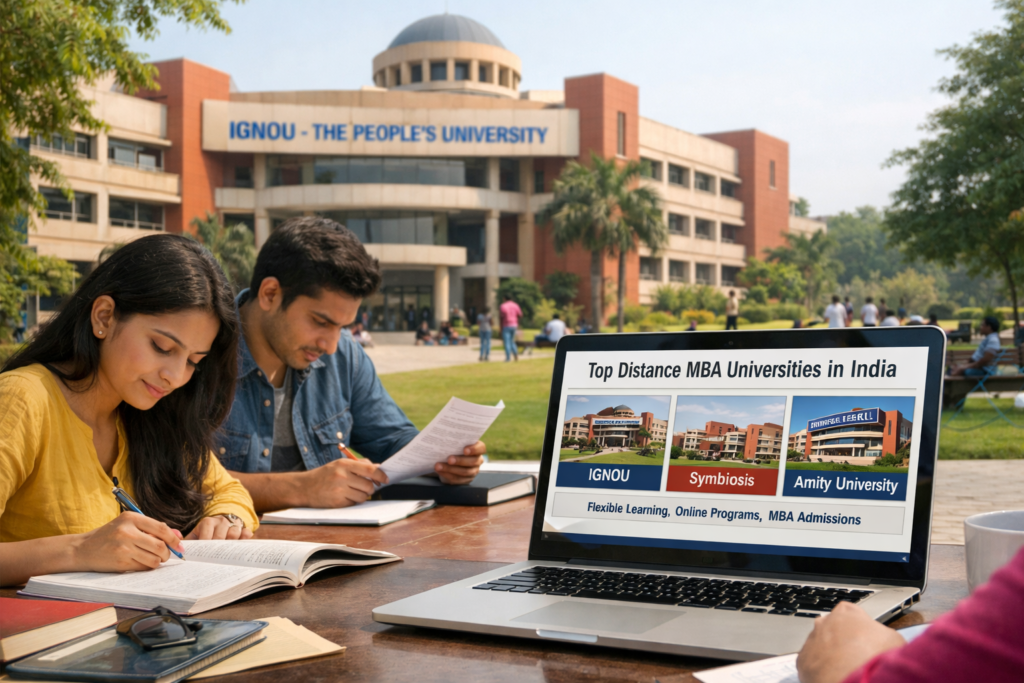
Assessment is primarily through annual or semester-end written examinations held at regional study centres. Some universities require assignment submission by post or through an online portal as part of internal assessment. Contact sessions — brief residential or day sessions with faculty — are offered by some universities a few times per year and are typically optional. Understanding Distance MBA in India 2026 helps you choose the right learning format and career path.
Distance versus online versus regular MBA
These three formats exist on a spectrum of interaction and immersion. A regular MBA is fully residential — you attend campus full-time, participate in daily classroom instruction, engage in live case discussions, and access campus placement. An online MBA is digitally delivered but structured — live sessions, LMS-based coursework, peer cohort interaction, and assessments.
A Distance MBA in India 2026 is self-directed — study materials, self-paced progress, and end-term examinations. The degree earned may carry the same name across all three modes, but the learning experience, the peer network developed, and the employer perception differ significantly. The distance format provides the credential at the lowest cost and interaction level.
Is distance MBA valid in India in 2026?
Yes — for institutions that are UGC-DEB recognised. The validity of a Distance MBA in India 2026 depends on the institution’s recognition status, not on the mode of delivery.
UGC-DEB regulation

The University Grants Commission Distance Education Bureau regulates distance and online degree programmes in India. An MBA from a UGC-DEB recognised institution is a legally valid master’s degree regardless of whether it was earned through campus attendance or correspondence. The UGC-DEB maintains a list of authorised institutions at ugcdeb.inflibnet.ac.in. Before enrolling in any Distance MBA in India 2026 programme, verifying that the institution appears on this list is the single most important due diligence step. Institutions not on the list are not authorised to grant recognised distance degrees, and a degree from an unrecognised institution has no legal standing. This clearly shows that Distance MBA in India 2026 is a valid and recognized degree option.
Government job eligibility
For government employment purposes, a distance MBA from a UGC-DEB recognised institution is fully equivalent to a regular MBA. Public Sector Undertakings (PSUs), central government departments, state government bodies, and regulated financial institutions use the minimum educational qualification framework, which treats the degree on its face — not by the mode through which it was earned. This is one of the clearest practical advantages of a recognised distance MBA: for promotions in government organisations, for meeting qualification requirements in public sector roles, and for eligibility criteria in government-run schemes, it functions equivalently.
Private sector perception
In the private sector, employer perception of a Distance MBA in India 2026 is more variable and depends heavily on the specific institution. A distance MBA from IGNOU is widely recognised and accepted, partly because IGNOU’s brand is nationally credible and partly because the institution has decades of history producing graduates in public and private employment. A distance MBA from a state open university with limited national recognition carries less weight. A Distance MBA in India 2026 from a small private institution — even if technically UGC-DEB listed — may carry negligible private sector employer recognition. The legal validity and the practical employer recognition are not the same thing.
Who should — and should not — consider a distance MBA
Profiles for whom it makes clear sense
Government employees seeking promotion or qualification upgrades are the strongest fit. Many central and state government roles have minimum qualification requirements that a Distance MBA in India 2026 can satisfy, and the promotional pathways in government organisations are more transparent about accepting recognised degrees regardless of mode. Budget-constrained candidates who need a master’s degree credential but cannot afford the fees of private institutions or the opportunity cost of a full-time programme are served by distance education in a way no other format matches — IGNOU at Rs 30,000 to Rs 60,000 is simply not replicable at any other quality level.
Working professionals in organisations that have a policy of recognising the credential for promotion — HR departments in some manufacturing, government-adjacent, and regulated sector companies often have explicit policies — benefit from distance MBA when it satisfies an internal promotion criterion. Candidates in areas with poor internet connectivity or without reliable access to video-capable devices face a genuine practical constraint that the distance format works around.
Who should not choose a distance MBA
Fresh graduates launching a management career in the private sector are poorly served by a Distance MBA in India 2026. Campus placement, peer networking, and the signal quality of a structured management education are absent in distance programmes. Candidates targeting competitive private sector management roles in marketing, finance, consulting, or analytics need either a campus MBA or a credible online MBA — the distance format does not open those doors.
Career-switchers who need the credential to execute a sector pivot also need the active career infrastructure that distance programmes do not provide. And anyone whose primary motivation is salary growth through career advancement in the private sector should set realistic expectations: a Distance MBA in India 2026 alone rarely drives salary jumps of the kind that campus or credible online programmes do through placement.
Top government universities offering distance MBA
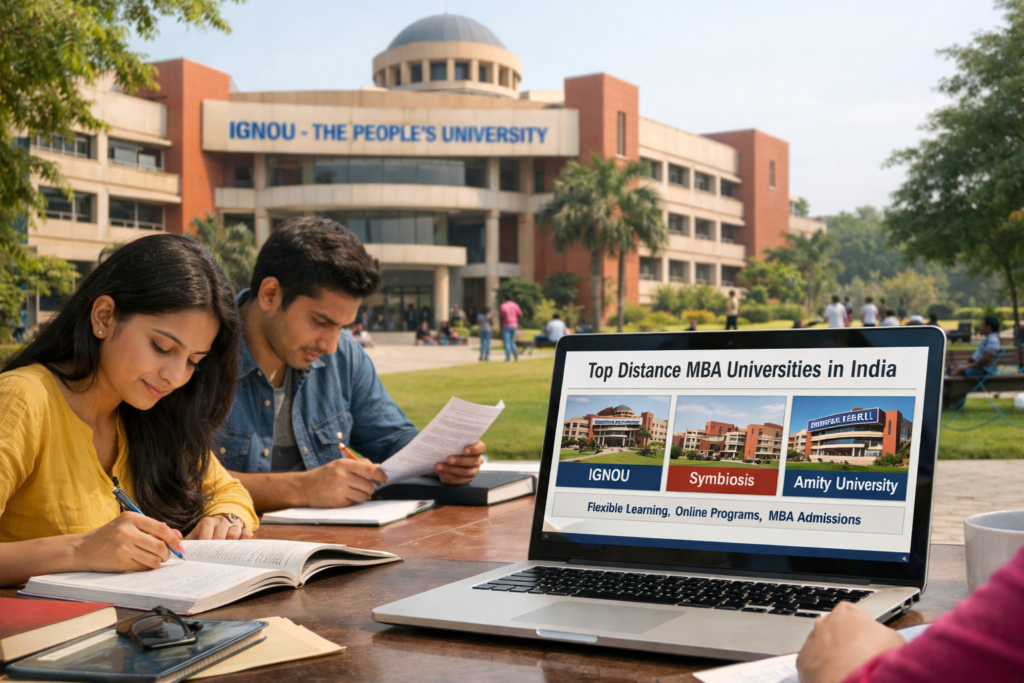
IGNOU
Indira Gandhi National Open University remains the most credible Distance MBA in India 2026 institution in India. Its MBA programme, accessible through the OPENMAT entrance test (which has a low qualifying threshold — essentially graduation from a recognised university), costs Rs 30,000 to Rs 60,000 for the full two years. IGNOU’s study materials are developed by faculty and subject matter experts and are considered among the better correspondence materials in Indian open education. Exams are conducted at regional centres across India. The IGNOU brand is nationally recognised, and an IGNOU MBA is accepted by government employers, PSUs, and many private sector organisations. There is no placement support — employment is entirely self-driven. The limitation of the IGNOU distance MBA is the same as all distance programmes: minimal faculty interaction, no peer cohort development, and limited private sector career acceleration beyond the credential itself.
State open universities
Yashwantrao Chavan Maharashtra Open University (YCMOU) and Karnataka State Open University (KSOU) are the largest and most recognised state-level distance MBA providers. YCMOU fees are Rs 15,000 to Rs 40,000; KSOU fees are Rs 12,000 to Rs 30,000. Both are UGC-DEB recognised and accepted for state government employment in their respective states. Their recognition outside the state is more limited — a YCMOU MBA carries stronger weight in Maharashtra than in Delhi or Bengaluru. For candidates whose employment targets are state-specific, these are functional and very low-cost options.
DDE programmes at conventional universities
Several conventional universities operate Directorates of Distance Education (DDE) that offer MBA programmes. Annamalai University in Tamil Nadu offers a well-established distance MBA at Rs 20,000 to Rs 50,000 through its DDE, with a track record of several decades and reasonably good recognition in the South Indian private sector and government contexts. Madurai Kamaraj University, Osmania University in Hyderabad, and Nalanda Open University serve their regional catchment areas similarly. These institutions are UGC-DEB listed and offer recognised degrees, but their employer recognition is primarily regional. Choosing the right college is an important step in Distance MBA in India 2026.
Top private universities offering distance MBA
Symbiosis SCDL
Symbiosis Centre for Distance MBA in India 2026 Learning is the most well-known private distance education provider in India. It is important to note that SCDL offers a Post Graduate Diploma in Business Administration (PGDBA), not a full MBA degree. Fees range from Rs 50,000 to Rs 1.2 lakh. The Symbiosis name carries recognition value, and the PGDBA is accepted in many private sector employment contexts. However, it is not equivalent to an MBA for purposes that specifically require a master’s degree — for university teaching eligibility, certain government service applications, or admission to PhD programmes. Candidates whose goal requires a full master’s degree must confirm whether the PGDBA meets that requirement before enrolling.
Amity University Distance and Manipal Distance Education
Amity University offers distance MBA programmes at Rs 80,000 to Rs 1.5 lakh and Manipal’s distance programmes are in the Rs 70,000 to Rs 1.2 lakh range. Both are UGC-DEB recognised and offer multiple specialisations. The study material quality is reasonable. Placement assistance for distance students is minimal — job fairs and portal access at most. The institutional brands carry moderate recognition in the private sector, though less than their campus programmes. For candidates between the very low-cost open university option and the higher-cost online programmes, these fill a mid-range bracket with slightly better academic infrastructure than state open universities.
Other private distance MBA providers
A large number of private universities and institutions advertise distance MBA in India 2026 programmes at various fee points. Before enrolling with any private provider, verify UGC-DEB recognition specifically, confirm that the programme being offered is a full MBA degree (not a diploma or certificate), and check when the institution received its recognition and whether it remains current. Some institutions that were previously UGC-DEB listed have had recognition suspended or lapsed. Verifying current status directly on the UGC-DEB portal is the only reliable method.
Distance MBA fees in India 2026

Distance MBA in India 2026 offers the most affordable access to a recognised management degree in India. The table below captures key institutions and their fee structure. Here is a detailed breakdown of Distance MBA in India 2026 fees and structure.
| Institution | Total Fees | Duration | Exam Mode | Value Perception |
| IGNOU | Rs 30-60K | 2-3 yrs | Study centres | Strong – govt & credential use |
| YCMOU Maharashtra | Rs 15-40K | 2 yrs | Study centres | Regional – Maharashtra focused |
| Karnataka State Open Univ | Rs 12-30K | 2 yrs | Study centres | Regional – Karnataka focused |
| Annamalai University (DDE) | Rs 20-50K | 2 yrs | Exam centres | Moderate – South India strength |
| Madurai Kamaraj Univ (DDE) | Rs 15-40K | 2 yrs | Exam centres | Moderate – Tamil Nadu base |
| Osmania University (DDE) | Rs 15-35K | 2 yrs | Exam centres | Regional – Telangana / AP |
| Symbiosis SCDL (PGDBA) | Rs 50K-1.2L | 2 yrs | Online proctored | Moderate – diploma not MBA |
| Amity University Distance | Rs 80K-1.5L | 2 yrs | Exam centres | Moderate – private sector limited |
| Manipal Distance Education | Rs 70K-1.2L | 2 yrs | Exam centres | Moderate – private sector limited |
The fees table reveals a clear pattern. Government open universities deliver the lowest costs — IGNOU, state open universities, and conventional DDE programmes all under Rs 60,000 for the full two-year programme. Private institutions add a fee premium that partially reflects better infrastructure and partially reflects brand premium. The Symbiosis SCDL entry is included with a note because it is frequently compared with distance MBAs despite being a diploma, not a degree — an important distinction. These affordable options make Distance MBA in India 2026 accessible to a wide range of students.
Hidden costs and true programme cost
The published fees cover tuition. Additional costs include: examination fees (Rs 500 to Rs 2,000 per semester at most open universities), study material shipping or download charges at some institutions (Rs 1,000 to Rs 3,000), travel to exam centres for candidates in remote areas, and optional contact session attendance if offered.
The total programme cost including these elements typically adds Rs 5,000 to Rs 15,000 to the headline fee. At IGNOU, the total out-of-pocket cost for a student completing the full programme is still well under Rs 1 lakh in most cases, making it the most financially accessible management credential in India.
Distance MBA salary in India — the realistic picture

The salary impact of a Distance MBA in India 2026 is the section most candidates want to read first and most providers answer least honestly. The direct answer: a distance MBA produces meaningful salary impact in specific, defined circumstances. In others, the impact is minimal. The career impact of Distance MBA in India 2026 depends on your experience and goals.
For working professionals already employed
The strongest salary case for a distance MBA is the government or quasi-government employee using it to qualify for a promotion that has a minimum educational qualification requirement. A candidate in a public sector role who moves from a non-degree to a degree qualification through a distance MBA may unlock a promotional track that was previously inaccessible — and the corresponding salary band. This is a real and often significant financial impact, but it is driven by the promotion structure, not by what the degree teaches.
In private organisations that have explicit policies recognising educational upgrades, a distance MBA can similarly support an internal promotion conversation. The credential supplements a promotion case built primarily on performance and experience. It is rarely the primary driver of a private sector salary increase — the work record is. Now let’s understand another important aspect of Distance MBA in India 2026.
For fresh graduates
The salary impact of a Distance MBA in India 2026 for a fresh graduate is low. Private sector employers hiring for management roles look for campus MBA placement, demonstrated academic rigour through competitive entrance exams, and peer cohort signals that distance programmes do not provide.
A fresh graduate with only a distance MBA competing for the same management trainee roles as campus MBA holders is at a structural disadvantage that the credential itself does not overcome. The honest use case for distance MBA is not as a management career launcher for fresh graduates — it is as a credential tool for employed professionals.
The experience reality
Salary after Distance MBA in India 2026 depends primarily on the candidate’s work experience, demonstrated skills, and industry positioning — not on the degree itself. The degree is a qualifier, not a career accelerator in the way that a campus MBA from a strong institution can be. Candidates who expect a Rs 10 to 15 lakh salary from a Rs 40,000 distance MBA without the work record to support it are likely to be disappointed.
Candidates who use it to unlock a promotion from Rs 6 lakh to Rs 8 lakh in an organisation where the credential matters for that specific transition — that is a financially sensible use of the tool.
Distance MBA versus online MBA
These two formats are frequently confused and are worth comparing directly on the parameters that matter for a candidate making a choice between them.
| Parameter | Distance MBA | Online MBA |
| Interaction Level | Low – printed material, self-study | Moderate to High – live sessions, LMS |
| Technology Required | Minimal – printed books, basic internet | Reliable internet, device required |
| Cost | Rs 15K – 1.5L (lowest tier) | Rs 50K – 14L (wider range) |
| Placement Support | None in most cases | Minimal to limited |
| Flexibility | High – fully self-paced | High – structured flexibility |
| Industry Perception | Low in private sector | Improving, esp. IIM-linked |
| Govt Job Eligibility | Yes – if UGC-DEB approved | Yes – if UGC-DEB approved |
| Best For | Budget-first, credential-only goals | Employed professionals upgrading career |
The comparison table reveals where the formats diverge most sharply. On cost at the bottom of the market, distance MBA wins decisively — state open universities at Rs 12,000 to Rs 40,000 have no online equivalent. On interaction quality and employer perception, online MBA is superior, particularly at the IIM-linked level where the gap is very significant. On technology accessibility, distance MBA requires less — a candidate without reliable broadband can complete a distance programme; an online MBA with live sessions requires consistent connectivity.
The candidate who should choose distance over online: primarily motivated by cost minimisation, needs a recognised degree credential for government promotion or qualification purposes, and does not have reliable broadband access. The candidate who should choose online over distance: employed professional targeting private sector advancement, willing to pay Rs 1.5 to Rs 5 lakh for better academic infrastructure, and wants some career service support alongside the credential. This comparison helps you decide whether Distance MBA in India 2026 is the right choice for you.
Distance MBA versus regular MBA
The gap between a distance MBA and a regular MBA is larger than the gap between online and regular MBA. The regular MBA — particularly from a Tier-1 institution — provides structured campus placement, a residential peer cohort that compounds professionally over a career, faculty access, case competition and club activity experience, and an alumni network built through shared physical time together. None of these exist in a distance programme.
Brand impact is the most visible difference. An IIM MBA credential opens doors immediately and continues compounding over 15 to 20 years through alumni network effects. An IGNOU distance MBA opens the doors for which it was designed — government employment, promotion qualification, basic private sector credential recognition — and is essentially invisible to the recruiters who source IIM graduates. These are different audiences, different jobs, and different career trajectories.
The campus MBA versus distance MBA comparison is relevant when a candidate is genuinely deciding between them — which requires both to be financially accessible and the placement question to be less central. That scenario is uncommon. Most candidates who choose distance MBA do so because the campus MBA is either financially out of reach or logistically impossible given their life circumstances. In that context, the comparison is not really between options — it is between a distance MBA and no MBA at all. For that comparison, the distance MBA from a recognised institution is clearly the better choice. To better understand Distance MBA in India 2026, you can also explore. If you want to understand the full MBA structure, fees, and admission process, you can also explore this detailed guide on MBA course in India 2026.
Specializations available in distance MBA
Distance MBA in India 2026 programmes typically offer the core functional specialisations that have been the backbone of management education for decades. Marketing, Finance, Human Resource Management, Operations Management, and International Business are available across most recognised distance MBA providers. IGNOU’s MBA includes both a general track and specialisation-adjacent electives. State open universities typically offer two to four specialisation tracks within their programme structure.
Business Analytics, Product Management, Healthcare Management, and Sustainability are significantly less available in distance MBA programmes. These newer specialisations require more interactive and technology-intensive delivery — live case workshops, software tool practice, and project-based learning — that do not translate well to a correspondence model. Candidates whose career goal requires one of these specialisations are better served by an online or campus programme that has invested in delivering the specialisation with the necessary interactive infrastructure.
Within the available specialisations, the depth of content in a distance MBA is adequate for foundational understanding but does not replicate the case discussion, live project, and peer learning dimensions that deepen specialisation knowledge in campus and online formats. A Finance specialisation from IGNOU covers the theoretical foundations of corporate finance, financial analysis, and banking. It does not replicate the financial modelling workshops, live case competitions, or alumni speaker series that develop the applied skills that campus programmes deliver.
Admission process for distance MBA 2026
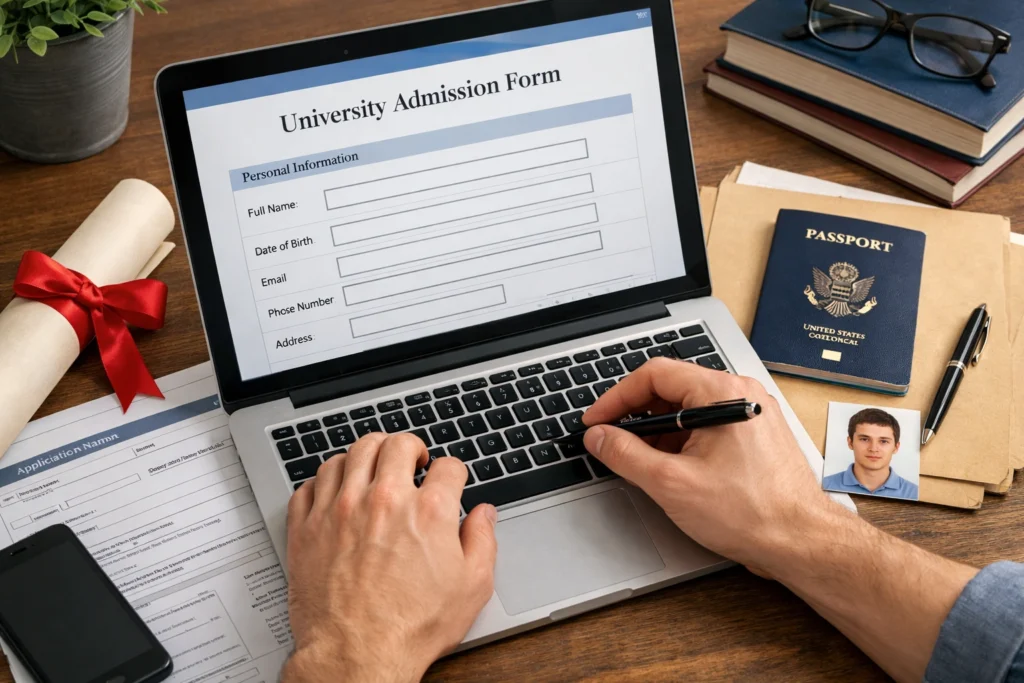
Distance MBA admission is the most straightforward of any MBA format. The process varies slightly between institutions but follows a consistent structure.
IGNOU requires candidates to appear for OPENMAT, its own entrance test conducted twice annually. OPENMAT has a low qualifying threshold — essentially requiring basic proficiency in quantitative aptitude, English, and general awareness, not competitive CAT-level preparation. Passing OPENMAT is the primary admission criterion alongside the standard 50% graduation requirement. State open universities typically admit on the basis of graduation marks alone, with no entrance test requirement. Most private distance MBA providers admit directly on the basis of graduation eligibility — 50% aggregate for general candidates, 45% for reserved categories — through a straightforward application and document submission process.
Application cycles at distance universities typically run twice a year — July and January intakes are common — though some institutions have moved to quarterly intakes. Documents required are the graduation certificate, identity proof, category certificate if applicable, and passport photographs. The absence of an entrance exam requirement and the twice-yearly intake cycle make distance MBA one of the most flexible entry points into management education in terms of when and how quickly a candidate can begin.
Pros and cons of distance MBA

What works in its favour
– Lowest cost of any recognised MBA format in India — IGNOU and state open universities under Rs 60,000 total, making the credential accessible regardless of financial situation
– No technology barrier — study materials, printed books, and local exam centres function without reliable broadband or video-capable devices
– Fully flexible schedule — completely self-paced, no fixed session times, no attendance requirement, compatible with any work schedule or location
– Government job and promotion eligibility — legally equivalent to campus MBA for regulated employment contexts that process credentials by degree type
These points clearly explain the advantages and limitations of Distance MBA in India 2026.
What works against it
– No placement support — self-placement is total; the institution provides no organised campus recruitment, no recruiter relationships, no alumni placement infrastructure
– Minimal academic interaction — limited or no live faculty contact, no peer cohort discussion, no case method learning; the intellectual development that comes from discussion-based learning is absent
– Low private sector career impact — for competitive private sector management roles, a distance MBA alone does not open doors that work experience and skills alone would not eventually open
– Self-discipline requirement with no external structure — two years of self-directed study alongside a full professional and personal life requires sustained motivation that many candidates underestimate. Understanding these factors is important before choosing Distance MBA in India 2026.
Common myths about distance MBA in India
Myth: Distance MBA is not a real or valid degree
False. A distance MBA from a UGC-DEB recognised institution is a legally valid master’s degree in business administration. The mode of delivery does not affect the legal standing of the credential. The confusion comes from the large number of unrecognised or lapsed-recognition providers who offer distance programmes that are not valid. The solution is verification, not generalisation.
Myth: Government jobs do not accept distance MBA
False. Government employment frameworks assess minimum educational qualifications on the basis of degree type and institutional recognition — not mode of delivery. A UGC-DEB recognised distance MBA satisfies the MBA minimum qualification requirement for government roles that specify it. Many government employees across central and state departments hold distance MBA degrees as their postgraduate qualification.
Myth: Distance MBA has zero value
Partially false and contextually dependent. For the purposes it is designed to serve — credential acquisition for promotion, government job qualification, affordable degree access — it has clear and functional value. For purposes it is not designed to serve — launching a competitive management career through institutional placement, building a high-value professional peer network, executing a major career pivot — it has limited value. Calling it zero value conflates the misaligned use case with the aligned one.
Myth: Distance MBA and online MBA are the same thing
False. Distance MBA and online MBA are distinct formats regulated under the same UGC-DEB framework but with meaningfully different delivery models, interaction levels, institutional fee ranges, and employer perceptions. Distance is self-study with printed materials and term-end exams. Online is structured digital delivery with live sessions, LMS platforms, and regular assessment. The distinction matters for choosing between them and for understanding what you are enrolled in.
What distance MBA is and what it is not
Distance MBA in India in 2026 is a functional, legally recognised, and financially accessible path to a management degree. It serves a specific population well and serves another population poorly. The clarity to make a good decision comes from knowing which population you belong to.
If you are a government employee seeking a promotion that requires a postgraduate management qualification, a candidate with genuine financial constraints who cannot access campus or credible online programmes, or a professional in a regulated sector where the credential type matters more than the mode — a distance MBA from IGNOU or another recognised institution is a practical, sensible, and financially efficient choice. The Rs 30,000 to Rs 60,000 investment to satisfy a qualification requirement that unlocks a higher salary band is straightforwardly good ROI.
If you are a fresh graduate launching a management career, a professional targeting competitive private sector advancement, or a candidate needing placement infrastructure to execute a career change — a distance MBA will not do the work you need done. The absence of placement, peer network, and interactive learning is not a minor limitation in those scenarios. It is the central limitation.
The myth that it should be cleared last: distance MBA is not a shortcut to a salary jump. It is a credential acquisition tool. For the candidates and purposes it is designed for, it is a good tool — affordable, accessible, legally valid, and practically useful. The candidates who are disappointed by it are typically the ones who used it as a substitute for a campus or online programme that their specific career goal actually required. Overall, Distance MBA in India 2026 is a practical option for specific career goals and budget needs. Before making a decision, it is important to evaluate all aspects of Distance MBA in India 2026.
Frequently asked questions
Is distance MBA valid in India?
Yes, from UGC-DEB recognised institutions. Verify at ugcdeb.inflibnet.ac.in before enrolling. IGNOU, state open universities, and their DDE departments are valid. Private providers vary — check each specifically. The degree itself says MBA and is legally equivalent to a campus MBA from the same institution. This is one of the most common questions related to Distance MBA in India 2026.
Can I get a job after distance MBA?
Yes, in specific contexts. Government and public sector roles, promotion-track private organisations that recognise the credential, and roles where the degree satisfies a minimum qualification requirement are the most natural landing zones. Competitive private sector management trainee roles accessed through campus recruitment are not accessible through distance MBA placements because those placements do not exist. The job outcome depends heavily on your existing work experience and the specific employment context. This makes Distance MBA in India 2026 a flexible option for many students.
Which is better: distance or online MBA?
It depends on your goal, budget, and internet access. For credential-only purposes at minimal cost without internet dependency: distance MBA, particularly IGNOU. For employed professionals wanting active career support alongside a credential, with reliable internet access: online MBA, particularly IIM Kozhikode or Indore for the best value combination. Distance is cheaper and simpler. Online is more interactive and more respected in private sector contexts. Neither is universally better.
What is the fee for distance MBA?
Government open universities: Rs 15,000 to Rs 60,000 total for the full programme. IGNOU specifically: Rs 30,000 to Rs 60,000. Private distance providers like Amity and Manipal: Rs 70,000 to Rs 1.5 lakh. Symbiosis SCDL (PGDBA, not MBA): Rs 50,000 to Rs 1.2 lakh. Distance MBA is the most affordable managed credential in Indian higher education.
Is distance MBA good for government jobs?
Yes. A UGC-DEB recognised distance MBA is legally equivalent to a campus MBA for government employment purposes. Central government, state government, PSUs, and regulated financial sector employers all process the credential on its face without distinguishing by mode. Many government employees across India hold distance MBA degrees obtained through IGNOU or state open universities.
Can I do distance MBA while working?
Yes. Distance MBA is structurally designed for working candidates. There are no fixed class times, no attendance requirements, and no live sessions to attend. Study happens on your own schedule using printed or PDF materials. Examination dates are fixed but announced well in advance and held at local centres. The programme is fully compatible with full-time employment, family responsibilities, and any work schedule.
Does distance MBA require CAT?
No, for most programmes. IGNOU uses its own OPENMAT entrance test, which has a low qualifying threshold and is significantly easier to clear than CAT. State open universities and most private distance providers admit directly on the basis of graduation eligibility — 50% aggregate for general candidates — without any entrance exam. The low entrance barrier is one of the defining characteristics of distance MBA admission across the market.