
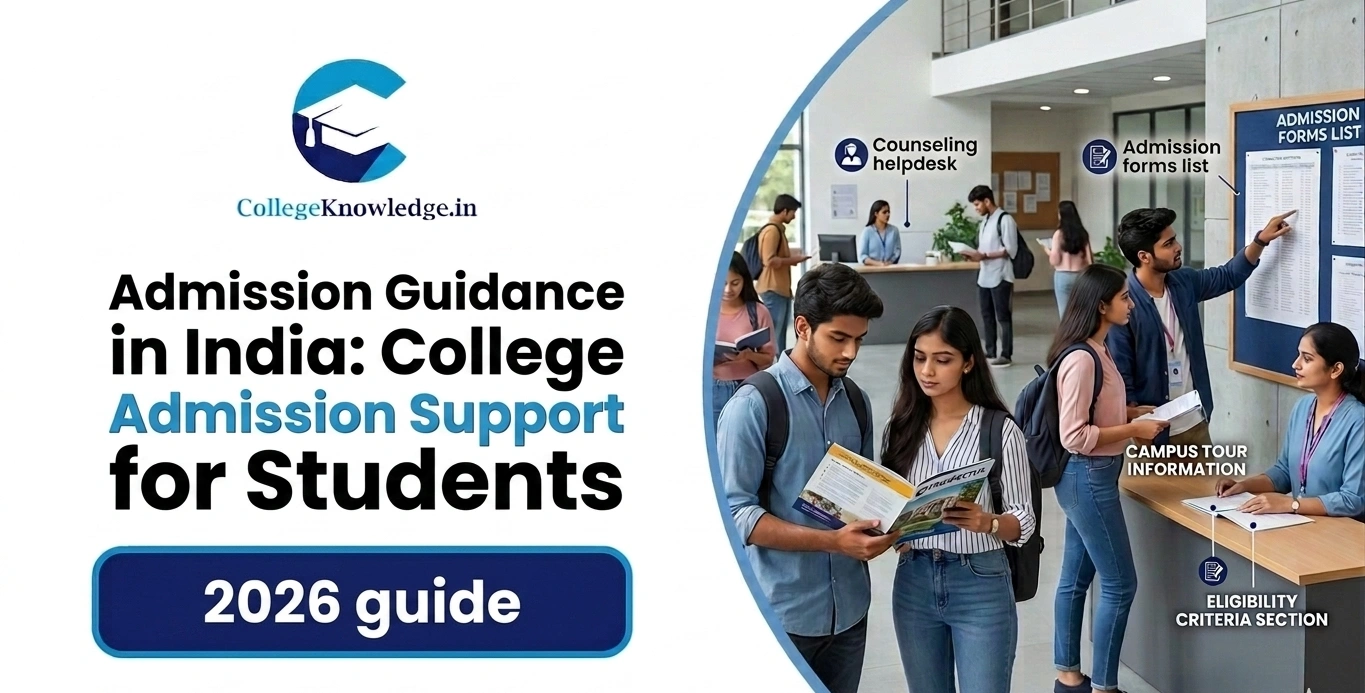
There’s a very specific moment most students describe — results are out, the score is known, and suddenly the real confusion begins. Which college? Which course? Government or private? Entrance exam counseling or direct admission? Everyone in the family has a different answer, every website has a different ranking, and the deadlines are already running.
Admission guidance in India refers to the structured support system that helps students navigate this entire process — from understanding which colleges match their profile, to preparing applications, to moving through counseling rounds, to finally confirming an admission that actually makes sense for their career and budget. It covers career counseling, college shortlisting, entrance exam guidance, documentation help, scholarship identification, and direct admission support where applicable.
The system sounds straightforward from the outside. Inside it, most students and parents discover it’s anything but.
Why Students Need Admission Guidance in India 2026

India now has over 1,000 universities and 43,000+ colleges. That number alone should explain why students feel overwhelmed — but the confusion runs deeper than just volume.
The admission process itself has layers. For engineering, there’s JEE Main, JEE Advanced, state-level entrance exams, and then multiple counseling rounds through JoSAA, state boards, and private universities — all with different cutoffs and different deadlines. For management programs, there’s CAT, MAT, XAT, CMAT, and CUET simultaneously. Medical admissions run entirely through NEET, with counseling through MCC and state bodies. Law has CLAT and university-level exams. And for students who didn’t crack any entrance exam at the level they needed — or who are looking at private universities directly — there’s a completely separate world of direct admission guidance to navigate.
Add to all of this: an AI-driven job market reshaping which careers are worth pursuing, rising education costs making ROI more important than ever, and the very human reality of family pressure and fear of making the wrong call. The result is that even academically capable students with clear enough scores find themselves paralyzed at the decision stage.
“There’s too much information online, but very little clarity.” That phrase, or some version of it, appears in almost every honest student discussion about admissions. That’s the gap college admission guidance is meant to fill.
Admission Guidance for Different Courses in India

Engineering Admissions
Run primarily through JEE Main and state entrance exams. The counseling process is multi-round and branch-preference-based, which means students need to think about specialization — not just institution — well before the process begins. AI, Computer Science, and Electronics branches have the strongest placement outcomes in 2026. Admission guidance in India for engineering students often focuses on helping them understand branch vs college trade-offs — a decision most students underestimate.
Medical Admissions
Through NEET are high-stakes and centralized. Beyond MBBS, allied health programs — Physiotherapy, Occupational Therapy, Nursing, and Paramedical courses — are increasingly viable career paths that good college counseling services should highlight for students who scored below the MBBS cutoff.
MBA and Management Admissions
MBA and Management Admissions are profile-driven and ROI-sensitive. CAT, XAT, NMAT, and SNAP target different college tiers. Students need guidance on realistic college shortlisting — matching actual percentile scores with genuine placement outcomes, not wishful thinking about top-tier programs they won’t get into.
Law Admissions
Through CLAT have become increasingly competitive. Five-year integrated LLB programs at National Law Universities are excellent, but university-level law schools also offer strong programs that students often overlook because they’re less discussed.
Design and Creative Courses
NID, NIFT, CEED-based programs — require portfolio preparation alongside entrance exams. Students rarely get guidance on this combination, and it’s a gap that costs them admission opportunities.
Commerce and Arts programs
B.Com, BBA, BA Economics, Mass Communication, Psychology — have a wide quality range across colleges. Student admission help here is really about knowing which institutions have strong faculty and placement networks, versus which are coasting on a recognizable name.
Government vs Private Colleges: What Should Students Actually Choose?
This is one of the most emotionally charged questions in college admission guidance in India, and the honest answer is more nuanced than either camp admits.
Government colleges — NITs, IITs, central universities, state government colleges — generally offer lower fees, strong peer environments, and in top institutions, excellent placement ecosystems. Competition for seats is intense, and infrastructure varies widely outside the premier institutions.
Private colleges and universities range from genuinely excellent — strong faculty, active industry tie-ups, good placement cells — to deeply mediocre, surviving on marketing budgets and management quota revenue. The range is enormous, which is precisely why blanket statements about private colleges being worse (or better) are both wrong.
The real question is ROI. A government college seat at 1.5 lakh per year with average placements of 6 LPA might be a better financial decision than a private college at 8 lakh per year with the same placements. But a well-run private university with 12 LPA average placements at 4 lakh per year might be a better investment than a government institution in a less competitive tier.
University admission help that cuts through this confusion — with real fee structures and real placement data side by side — is what students actually need.
How Admission Counselors Help Students

A good admission consultant India does something specific: they create structure out of chaos.
Profile evaluation comes first — mapping a student’s scores, interests, and budget against realistic options. Not the best-case scenario, not the worst, but the actual realistic range. Then comes college shortlisting based on verified placement records, accreditation status, and course quality — not brochure claims.
From there, counselors help with application planning and deadline management, which matters more than students realize. Missing a counseling round or submitting documentation incorrectly can cost a seat. Scholarship identification is another underused service — many students qualify for fee waivers or merit scholarships they never applied for because nobody told them about it.
Platforms like College Knowledge bring this together in one place — 25+ universities, 100+ courses, real placement comparisons, and expert counselors who evaluate your profile before making recommendations. That’s the difference between admission counseling services and a sales call disguised as one.
Can Students Get Direct Admission in India?
Yes — and this is a legitimate, legal route that more students should understand clearly.
Direct college admission guidance in India works primarily through management quota seats, which private and deemed universities are legally permitted to fill outside the regular merit-based counseling process. These seats typically carry higher fees than merit seats, but they represent a real option for students who missed cutoffs, who are looking at specific programs not covered by entrance counseling, or who have geographic or timing constraints.
Direct admission guidance from an honest counselor covers the actual fee structure (not just the one on the website), the institution’s recognition status, NAAC/UGC accreditation, and realistic placement outcomes for that specific program. It does not involve guaranteed admission promises, large upfront cash payments with no documentation, or vague claims about “connections.”
The legal, transparent version of direct admission counseling exists and is useful. The version that asks for cash in exchange for a seat confirmation is a scam. Knowing the difference is important before engaging anyone claiming to offer this service.
Common Admission Mistakes Students Make
Choosing a college based on its social media presence rather than its placement data. A well-photographed campus is not a career outcome.
Missing counseling round deadlines because the process wasn’t tracked properly. Every counseling round that closes is an option gone — permanently.
Panic admissions — confirming a seat at a mediocre institution simply to have something confirmed, without properly exploring options that were still open.
Trusting fake admission consultants who promise outcomes nobody can guarantee and charge fees upfront with no accountability.
Ignoring the total fee structure. Many students calculate tuition and miss hostel, exam fees, lab fees, and annual charges that add 30–40% to the stated cost.
And following a friend to a college or course that fits the friend’s goals, not their own.
Step-by-Step College Admission Process in India
| Step | What Happens |
| Step 1 | Career and course selection based on interests and scores |
| Step 2 | Entrance exam preparation and registration |
| Step 3 | College research — placements, fees, accreditation |
| Step 4 | Application submission across shortlisted colleges |
| Step 5 | Counseling rounds — preference filling and seat allotment |
| Step 6 | Document verification and fee payment |
| Step 7 | Final admission confirmation and enrollment |
Documents Required for College Admissions
| Document | Purpose |
| Class 10 Marksheet | Academic history verification |
| Class 12 Marksheet | Core eligibility proof |
| Entrance Exam Scorecard | Merit-based admission process |
| Aadhaar / ID Proof | Identity verification |
| Passport-size Photographs | Application and ID card processing |
| Transfer Certificate | Previous institution clearance |
| Caste / Category Certificate (if applicable) | Reservation documentation |
| Income Certificate (if applicable) | Scholarship eligibility |
Questions Students Should Ask Before Taking Admission
What is the average placement package for this specific course — not the highest, the average? Does the college actively place students in internships, or just mention internships in the brochure? What is the complete fee structure, including all annual charges? Is the degree recognized by UGC and relevant professional bodies? What do students from the last two batches say about the actual experience?
These are uncomfortable questions to ask. They’re significantly less uncomfortable than regretting the admission two years in.
Conclusion
Admission guidance in India isn’t a luxury for confused students — it’s a practical necessity in a system that has become genuinely difficult to navigate alone. The right support doesn’t just help students get into a college. It helps them get into the right one, for the right reasons, with a realistic picture of what comes next. That difference is worth more than any guarantee an unethical consultant will offer.
Get Free Admission Guidance — Personalized for Your Profile
Confused about colleges, counseling rounds, or whether direct admission is right for your situation? College Knowledge connects students with expert counselors who compare real universities, real placement data, and real fee structures — so you make an informed decision, not a pressured one. Free consultation, 25+ universities, 100+ courses. Start here.
People Also Ask — FAQs
Q1. What is admission guidance?
It’s a structured support service that helps students through the entire college admission process — from career and course selection to college shortlisting, application support, counseling rounds, and final enrollment.
Q2. Is admission counseling worth it?
For most students, especially those navigating multiple entrance exams, counseling rounds, or direct admission routes — yes. It reduces mistakes, saves time, and often leads to better college outcomes than going through the process alone.
Q3. Can I get direct admission in India?
Yes. Management quota and private university direct admissions are legal routes available to students who missed merit cutoffs or are looking for specific programs. A transparent admission consultant India can guide you through this process properly.
Q4. How do I choose the right college?
Compare placement data for your specific course, verify accreditation, understand the complete fee structure, and check alumni feedback — not just the college’s own marketing material. College admission support from a reliable counselor makes this comparison systematic.
Q5. Can counselors help students with low marks?
Yes. Admission counseling services for lower-scoring students focus on identifying realistic, quality options — including direct admissions, management quota seats, and private universities with strong career outcomes for that profile.
Q6. How do I avoid fake admission consultants?
Avoid anyone promising guaranteed admissions, asking for large upfront cash payments, or recommending only a narrow set of colleges. Genuine educational guidance India is transparent, process-driven, and student-focused — not commission-driven.