Finishing Class 12 often feels less like an achievement and more like suddenly being handed a map with no legend. Engineering, medicine, law, design, data science, MBA, government jobs, study abroad, and somewhere in the middle of all of that, a relative leaning across the dinner table saying “just do engineering, it’s safe.” The advice doesn’t stop. The clarity does.
Career counseling after 12th is a structured process where students work with a counselor, or a guidance platform, to identify their strengths, understand their options, and make a career decision based on something more reliable than panic or peer pressure.

It typically includes aptitude analysis, stream-wise career mapping, course selection guidance, college counseling, and in many cases, psychometric assessments that help students understand where their natural inclinations actually lie.
The goal isn’t to hand a student a list of “top 10 careers.” It’s to help them figure out which direction actually makes sense for them, their personality, their scores, their financial reality, and yes, their interests too.
Why Students Feel So Confused After 12th in 2026
Here’s something most career guides won’t say directly: the confusion students feel after 12th isn’t a personal failing. It’s a completely rational response to a genuinely overwhelming situation.
A 17 or 18-year-old is expected to make a decision that shapes the next decade of their life, often within weeks of board results, with incomplete information, and under significant social pressure. Parents have expectations, sometimes spoken, sometimes just felt.
Friends seem to have figured it out already (they haven’t, they’re just quieter about the confusion). Social media shows success stories at 22 and makes everyone feel behind before they’ve even started.
And then there’s the AI factor. Careers that seemed safe five years ago are being reshaped. New fields are emerging that didn’t exist when current textbooks were written. Students are genuinely unsure whether the path they choose will still be relevant when they graduate.
What students in Reddit discussions and forums say, repeatedly, is that they don’t need more motivation, they need clarity. Someone to help them think through the actual decision, not just encourage them to “follow their dreams” without any practical framework.
That’s what real career counseling after 12th looks like.
Best Career Options After 12th Science
Science students have the widest range of options, which ironically makes the decision harder, not easier.
Engineering and AI careers
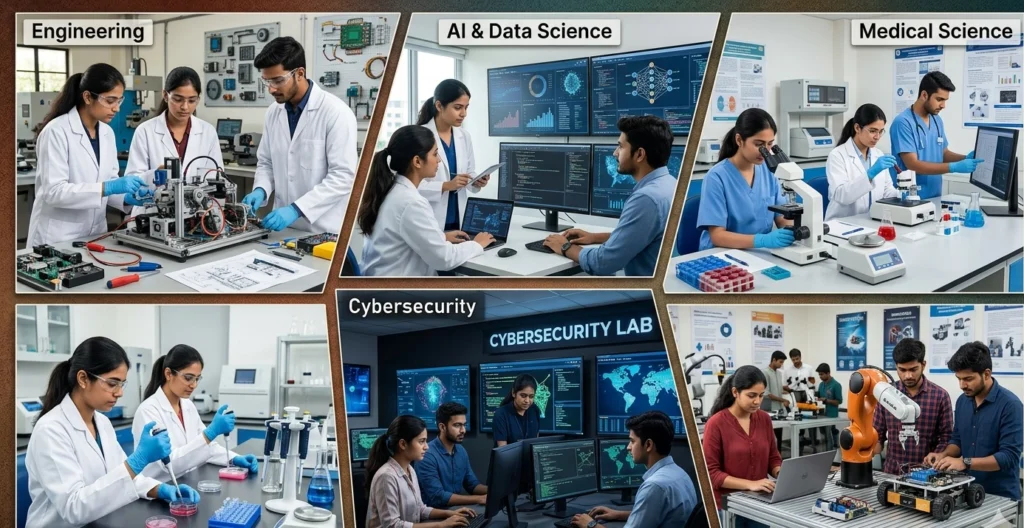
Engineering and AI careers remain among the strongest bets, but the branch matters enormously. Computer Science, AI/ML specializations, and Data Science are seeing consistent demand. Mechanical and Civil Engineering are more market-dependent. Choosing engineering without thinking about the specialization is a common mistake.
Medical and allied health,
MBBS, BDS, Physiotherapy, and Occupational Therapy require long commitment but offer stable, meaningful careers. The competition for MBBS seats through NEET is intense, but allied health programs are increasingly viable and underrated.
Data Science and Cybersecurity
Data Science and Cybersecurity are genuinely future-proof fields in 2026. Both can be entered through specialized undergraduate programs and don’t necessarily require a traditional engineering degree.
Biotechnology and Research
Biotechnology and Research suit students who are analytically curious and patient, the career trajectory is slower, but the long-term scope, especially in pharmaceuticals and genomics, is significant.
Aviation, Robotics, and emerging tech programs
Aviation, Robotics, and emerging tech programs are worth serious consideration for students who scored well and have clear interest in applied sciences.
The honest framing here: Science gives you options. Career counseling after 12th for science students is really about narrowing those options intelligently, not grabbing the most famous-sounding one.
Best Career Options After 12th Commerce
Commerce students often face a different kind of confusion, not too many dramatic options, but too many paths that sound similar until you’re three years into one.
CA, CS, and CMA
These are rigorous, respected, and extremely career-stable. They require serious commitment and pass rates are tough, but students who complete them have very strong career floors.
BBA and general management programs
These programs are good entry points for students who want to move toward business, marketing, or entrepreneurship. The quality of the college matters here, a BBA from a strong institution with good internship placements is a genuinely useful degree.
Finance and Investment Banking
As a career track is competitive but well-compensated. Students interested in this space should be thinking about CFA alongside their undergraduate degree.
Business Analytics and Digital Marketing
These are the newer entrants that have real market demand. Both can be started with undergraduate programs and built through certifications and practical experience.
Commerce students at platforms like College Knowledge often find that the comparison between BBA, B.Com, and integrated MBA programs is where they need the most career counseling after 12th, because the differences between these paths aren’t obvious from the outside.
Best Career Options After 12th Arts
Arts students get the least useful career advice, usually because the people giving advice aren’t familiar with the actual landscape.
Law
Law through CLAT or university-level entrance exams, is one of the most underestimated career paths in India. It’s intellectually demanding, increasingly well-compensated, and has strong long-term growth especially in corporate and IP law.
Psychology
Psychology has seen a genuine surge in career viability. Clinical psychology, counseling, organizational psychology, all of these are fields with growing demand and the ability to make meaningful impact.
Journalism, Media, and Communication
Journalism, Media, and Communication suit students who are naturally curious and comfortable with ambiguity. Digital media especially has created roles that didn’t exist ten years ago.
Design and Animation
Graphic design, UI/UX, motion design, game design, are legitimate career paths with strong market demand, especially as digital-first businesses become the norm.
UPSC and Public Policy
remain aspirational paths for students drawn to governance. The timeline is long, but for students with genuine interest, it’s one of the most respected career trajectories in the country.
Arts students don’t have fewer options. They have options that require more navigation, which is exactly where student counseling after 12th adds the most value.
How Career Counseling Actually Helps
The practical value of professional career counseling after 12th isn’t inspiration. It’s structure.
A good counselor helps identify where a student’s actual strengths lie, not the ones they’ve been told about, but the ones that show up consistently. They help map those strengths against realistic career paths, including what the daily reality of that career looks like (not just the salary at the peak of it).
They compare course options across colleges with actual placement data attached. And they help students build a long-term roadmap instead of just picking a college for this year.
What this does, practically, is replace paralysis with a sequence. Students who go through proper career decision counseling don’t necessarily make perfect decisions, but they make informed ones, which is far better than the alternative.
Passion vs Salary: What Should Students Actually Prioritize?
This is the question that comes up in almost every honest career conversation, and the answer is more nuanced than either side of the debate admits.
Purely following passion without considering market reality is a real risk. A genuine interest in something obscure doesn’t automatically create a sustainable career. But purely chasing salary in a field you have no interest in creates a different kind of problem, the kind where you’re miserable at 28, earning well, and wondering how to start over.
The more useful framing: find the overlap. What do you find interesting that also has genuine market demand? That intersection exists in more places than students think, but finding it requires actual research, not wishful thinking or parental anxiety.
Career advice for students that doesn’t acknowledge both sides of this is incomplete. Counseling that helps students find the overlap is genuinely useful.
Common Career Mistakes Students Make After 12th

Following trends blindly, choosing Data Science or AI because everyone is talking about it, without any real interest in the underlying work. These fields reward genuine curiosity. Faking it for three years is exhausting.
Choosing careers based on what relatives suggested. Relatives mean well. They also often have information that’s 15 years out of date.
Ignoring aptitude. A student who hates numbers but chooses CA because it’s “safe” is going to have a very hard few years. Aptitude isn’t everything, but fighting against it constantly is a tax on energy and performance.
Selecting colleges without researching placements. The college name matters, but the placement data for your specific course matters more.
And the classic: confusing a career’s popular image with its daily reality. Law looks glamorous from the outside. The first few years involve a lot of unglamorous document work. That’s fine, but students should know before they commit.
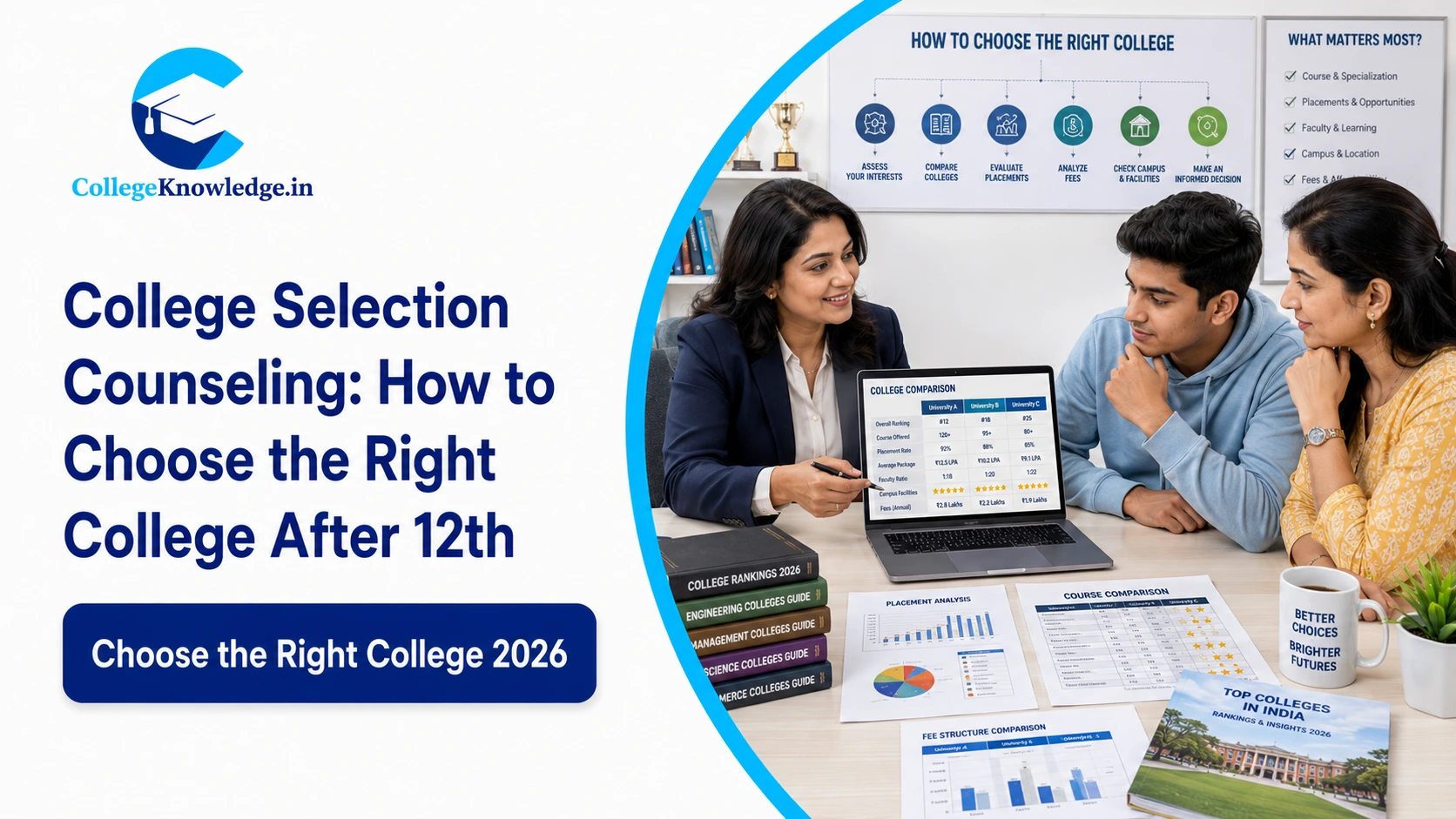
Step-by-Step Career Decision Process After 12th
| Step | What Students Should Do |
| Step 1 | Honestly identify interests and natural strengths |
| Step 2 | Research careers that align, including daily realities |
| Step 3 | Compare courses and college options with placement data |
| Step 4 | Analyze salary ranges and long-term growth potential |
| Step 5 | Talk to a career counselor for a structured second opinion |
| Step 6 | Build a 3–5 year roadmap, not just a “which college” decision |
Questions Students Should Ask Themselves Before Choosing a Career
What kind of work environment do I actually thrive in, structured or open-ended? Do I prefer stability or am I comfortable with uncertainty? Am I choosing this because it genuinely interests me, or because the people around me expect it? What does a Tuesday afternoon in this career actually look like, not the best day, the ordinary one? And five years from now, is this field likely to grow, stay stable, or shrink?
These aren’t easy questions. But asking them before choosing is a lot less painful than asking them after.
Conclusion
Career decisions after 12th are hard, not because students aren’t capable of making them, but because they’re being made under pressure, with incomplete information, at a moment when everything feels permanent. Career counseling after 12th doesn’t make the decision for you. It makes the decision clearer.
And clear decisions, made with real information and honest self-assessment, tend to hold up a lot better over time than the ones made out of panic or someone else’s expectations.
Get Personalized Career Counseling, Free, No Pressure
Still standing at that crossroads? Not sure which stream, course, or college fits where you actually want to go? College Knowledge offers free, expert-led career counseling for students after 12th, with real university comparisons, course-level placement data, and counselors who listen before they recommend. No generic lists. No pressure tactics. Just clarity. Start your conversation today.
Which Are the Best Career Options in 2026?
The best career options in 2026 are those that combine long-term market demand with personal interest and aptitude. Fields such as Artificial Intelligence, Data Science, Cybersecurity, Healthcare, Digital Marketing, Environmental Science, UX Design, Law, and Business Analytics continue to show strong growth potential.
However, the “best” career is rarely the same for every student. A career path that matches both individual strengths and industry demand tends to produce better long-term outcomes than simply following trends.
How to Choose a Career in 2026?
Choosing a career in 2026 requires balancing personal interests with practical market realities. Students should evaluate their strengths, aptitude, preferred work environment, growth opportunities within the field, and long-term earning potential.
Researching career paths, speaking with professionals, and seeking career counseling after 12th can help students make informed decisions based on real-world opportunities rather than assumptions or social pressure.
FAQs
Q.1 What is career counseling after 12th?
It’s a guided process that helps students identify their strengths, explore career options stream-wise, and make informed decisions about courses and colleges based on their aptitude, interests, and goals.
Q.2 Is career counseling worth it?
For most students, yes. A good counselor replaces confusion with structure and helps students evaluate career options, courses, and colleges more effectively.
Q.3 Can ChatGPT give career advice?
ChatGPT can help students explore career options, understand courses, and research industries. However, personalized career counseling that considers aptitude, goals, academic performance, and individual circumstances often provides more targeted guidance.
Q.4 Which is the best career option after 12th?
There is no single best career option after 12th. The right choice depends on a student’s interests, aptitude, career goals, and preferred work environment. Popular options include Engineering, Medicine, Law, Data Science, Business Management, Design, and Psychology.
Q.5 Can average students still build successful careers?
Absolutely. Academic scores are only one factor in long-term success. Many successful professionals built strong careers through consistent learning, skill development, and choosing fields that matched their strengths.
Q.6 What are the best future careers in 2026?
AI and Machine Learning, Data Science, Cybersecurity, Healthcare, Environmental Science, UX Design, Digital Marketing, Business Analytics, and Law are among the fastest-growing career paths based on current industry demand.