You’ve probably heard this advice: ‘prepare for the entrance exam, plan early, start in Class 11.’ And for a lot of students that advice lands too late, or in the middle of everything going wrong, or just after results that felt like a closed door.
Many students don’t realise that admission after 12th without entrance exam is possible through several private universities, open universities, and state-affiliated colleges across India. Students who may not have scored very high marks can still explore several best courses after 12th with low marks that offer practical skills and strong career opportunities.
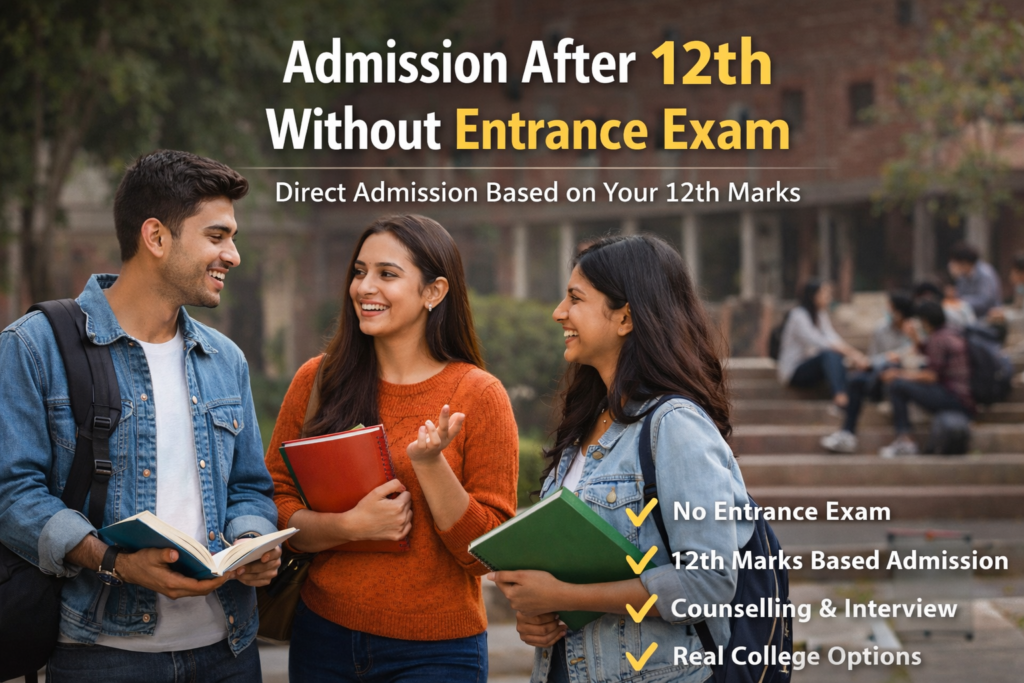
But here’s a truth worth sitting with. There are real colleges, real programs, and real pathways for admission after 12th without entrance exam. No JEE. No NEET. No CUET. Direct admission based on your 12th marks and sometimes just an interview or a counselling session.
This piece maps those options clearly.
Can you get admission after 12th without entrance exam?
Yes, it is possible to get admission in colleges after completing 12th without an entrance exam. There are private universities, open universities, state government colleges, and vocational colleges that offer direct admission to students based on their 12th marks, counseling, or interview. Some of the popular courses that can be pursued are BA, BCom, BBA, BSc, hotel management, and design courses.
Why Some Colleges Offer Admission After 12th Without Entrance Exam
The availability of admission after 12th without entrance exam depends largely on the type of institution and its admission policies.
Not every college is mandated to conduct entrance exams. Private deemed universities, state-affiliated colleges, open universities, and many vocational institutes offer direct admission after 12th without any entrance test requirement.
The reasons vary — some prioritise access over selectivity, some have enough seats to fill without the filter of an exam, some offer programs that don’t traditionally require entrance tests (arts, commerce, hospitality, design). Whatever the reason, it creates a real opening for students who either missed exam cycles or simply don’t test well under pressure.
Programs Most Commonly Available Without Entrance Exams
Many of these programs are designed specifically for students seeking admission after 12th without entrance exam through merit-based selection. Arts and humanities programs are the most accessible. BA in History, Political Science, Sociology, Philosophy, Geography, and English Literature at state universities across India admit students on the basis of 12th marks alone. No entrance exam. No interview in most cases. Just the application, the marks, and the counselling process.
Commerce programs follow close behind. B.Com and BBA at many private and state colleges operate on direct merit-based admission after 12th. Some private colleges even offer BBA with as low as 45% cutoff and zero entrance exam requirement.
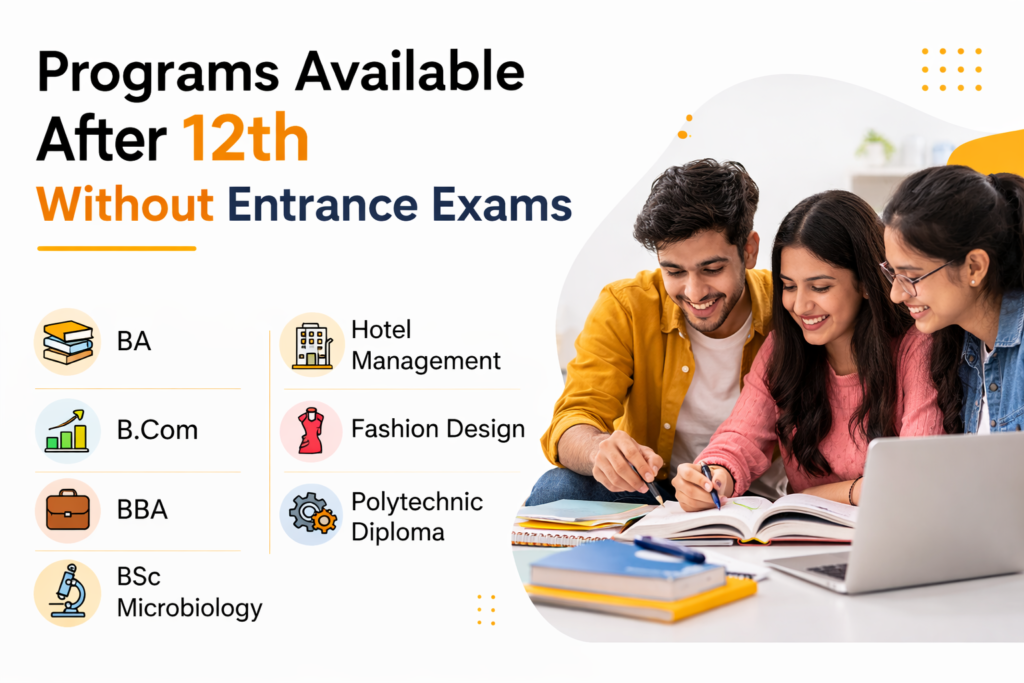
Design and fashion courses — at institutes like Pearl Academy, NIFT partner programs, and private fashion schools — sometimes offer direct admission based on a portfolio review or basic interview rather than a formal entrance test.
Hotel management and hospitality programs at non-IHM government institutes and private hospitality colleges also commonly offer admission after 12th without entrance exam. These programs lead to strong employment in aviation, hotels, and food service.
While undergraduate programs often allow direct admission, management programs like the MBA course in India usually require entrance exams and specific eligibility criteria.
Courses Available Without Entrance Exam After 12th
| Course | Stream | Admission Basis |
|---|---|---|
| BA | Arts | 12th marks |
| B.Com | Commerce | Merit based |
| BBA | Commerce/Management | Direct admission |
| BSc Microbiology | Science | Merit |
| Hotel Management | Hospitality | Interview / Merit |
| Fashion Design | Design | Portfolio / Interview |
Colleges and Institutions That Offer Direct Admission
IGNOU offers undergraduate programs in arts, commerce, science, and vocational fields with no entrance exam for most programs. It’s the largest open university in the world and offers some of the most accessible pathways for admission without entrance exam after 12th.
Symbiosis Open University and NMIMS Global Access School offer BBA, B.Com, and BA programs through distance/online mode without entrance tests, and their degrees are increasingly recognised in private sector employment.
Across India, several institutions now offer admission after 12th without entrance exam through direct merit-based admissions.
Amrapali University, Shri Venkateshwara University, Teerthanker Mahaveer University and several other private deemed universities in Uttar Pradesh and Uttarakhand offer direct admission for most undergraduate programs — you apply, sometimes appear for a counselling session, and get admitted without any formal entrance exam.
State-affiliated colleges in Rajasthan, Madhya Pradesh, Bihar, Jharkhand, and Chhattisgarh — especially for arts and commerce — admit students through centralised counselling without a separate entrance exam. The 12th percentage is the primary filter.
Polytechnics and ITIs across every state offer direct admission for diploma and trade certificate programs without entrance exams. Admission is typically based on 10th or 12th marks and a counselling process.
Courses in Science Without a Formal Entrance Exam
Science students often assume every pathway requires clearing NEET or JEE. This isn’t true. BSc Agriculture admissions in many states happen through centralised counselling without a dedicated entrance exam. BSc in Microbiology, Biotechnology, Environmental Science, and allied health sciences at private colleges often have direct admission after 12th without entrance exam with 45-55% minimum marks.
Even in science streams, admission after 12th without entrance exam is possible in several BSc and allied health programs.
BSc Nursing at private nursing colleges sometimes admits based on 12th PCB marks without a separate entrance test, though this varies by state and institution. Always verify current admission norms directly with the college, since policies do change year to year.
What the Admission Process Usually Looks Like
Without an entrance exam, the process is usually more direct but still requires some preparation. Here’s how it typically goes:
The process for admission after 12th without entrance exam is usually simpler but still requires proper documentation and counselling.
• Application form submission (online or in-person) — most colleges have their own portals now
• Document verification — 10th marksheet, 12th marksheet, ID proof, category certificate if applicable
• Counselling session — at some colleges this is just a formality, at others it involves a brief personal interview or aptitude conversation
• Seat allotment based on merit in the applied category
• Fee payment and enrollment within the specified window
For colleges offering admission after 12th without entrance exam, the counselling session can sometimes be done online, making it easier for students applying to colleges in other cities.
Things to Watch Out For
While exploring admission after 12th without entrance exam, students should carefully evaluate the credibility and accreditation of the institution. Not every college offering direct admission is a good college. The absence of an entrance exam doesn’t automatically signal quality — but it doesn’t signal its absence either. When evaluating any college that claims direct admission after 12th, check for:
• NAAC accreditation grade — A or B is generally acceptable
• UGC or AICTE recognition depending on the program
• Placement records — ask specifically, not just ‘highest package’ claims
• Alumni presence on LinkedIn — this tells you more than a brochure
• Faculty qualifications — look for PhD holders or industry professionals, not just guest lecturers
A college with direct admission and a genuine NAAC B+ accreditation is a far better choice than an unaccredited institution regardless of how easy the process sounds.
Professional courses like MBA usually require entrance exams such as CAT or XAT. Students planning management careers should understand the MBA admission 2026 in India process before applying.
Combining Direct Admission With Skill Development
One of the smartest moves a student can make — especially when taking admission after 12th without entrance exam — is to pair the degree program with active skill development from year one. Certifications, internships, freelance work, competitions.
tStudents who take admission after 12th without entrance exam can still build strong career prospects through skill development and internships.

A student who graduates from a direct-admission BA program with three certifications, a portfolio of work, and actual internship experience is genuinely competitive. The ‘better’ college down the street with no real-world exposure is not automatically a stronger candidate.
Your degree is the credential. Your skills are the substance. Build both.
Conclusion
There are hundreds of colleges across India offering admission after 12th without entrance exam — from IGNOU and state open universities to private deemed institutions and polytechnics. Arts, commerce, hospitality, agriculture, design, and science programs are all accessible through direct merit-based routes. The key is to research carefully, verify accreditation, and choose based on the program quality and career outcomes rather than just ease of entry. Getting in is the start. What you build inside matters more.
FAQs
1. Which colleges offer direct admission after 12th without entrance exam?
IGNOU, Symbiosis Open University, NMIMS Global Access, several private deemed universities in UP and Uttarakhand, and most state-affiliated arts and commerce colleges offer admission after 12th without entrance exam. Polytechnics and ITIs also follow this route for diploma programs.
2. Is direct admission after 12th valid for government jobs?
Yes, as long as the institution is UGC-recognised or affiliated with a recognised university. IGNOU degrees, state university degrees, and accredited private university degrees are all valid for government job eligibility.
3. Can I get into a B.Tech program without entrance exam?
Directly, it’s difficult — most B.Tech programs require JEE or state-level engineering entrance exams. However, a polytechnic diploma in engineering opens lateral entry to B.Tech second year, bypassing the 12th entrance exam route entirely.
4. What documents are needed for direct admission after 12th?
Typically: 10th marksheet, 12th marksheet, transfer certificate, migration certificate (if applicable), ID proof, passport photos, and category certificate if applicable. Always check the specific college’s requirements.
5. Are colleges with direct admission recognised by employers?
Accredited, UGC-recognised colleges are generally accepted by employers. The recognition depends on accreditation, not on the admission process. A NAAC-accredited college with direct admission is more valuable than an unrecognised college with a difficult entrance exam.