It’s late and you’ve been staring at that marksheet for a while now. Many students start searching what to do after 12th with low percentage when board results don’t meet expectations. From a relative. From a teacher. Even from yourself in the mirror.
This piece isn’t going to be that. This is for people who want actual answers, not reassurance that evaporates by morning.
Low percentage after 12th doesn’t mean low options. It means your particular path into the future looks different from what was expected. That’s it. Different, not lesser. Let’s talk about what’s actually in front of you.
Students wondering what to do after 12th with low percentage still have many career options. Diploma courses, vocational training, government exam preparation, and open university degrees are popular paths that focus on practical skills rather than board exam marks.

What to Do After 12th With Low Percentage: Stop Comparing and Start Mapping Your Career
The biggest trap right now is looking at what your classmates are doing and building your choices around theirs. Someone else’s cutoff isn’t your ceiling. Someone else’s fear isn’t yours to carry.
When thinking about what to do after 12th with a low percentage, the first honest question is: what do you actually want to do? Not what sounds safe. Not what your parents want to tell relatives. What do you care about enough to spend three to five years building skill in?
Career clarity is more valuable than a college name right now. Seriously.
Diploma and Polytechnic Courses — Underrated and Underused
Polytechnic diplomas are one of the most practical options after 12th with low marks. A three-year diploma in civil, mechanical, electrical, or computer engineering is industry-facing, affordable, and teaches real skills that employers actually want. Polytechnic diplomas are often recommended for students wondering what to do after 12th with low percentage because they focus on practical skills.
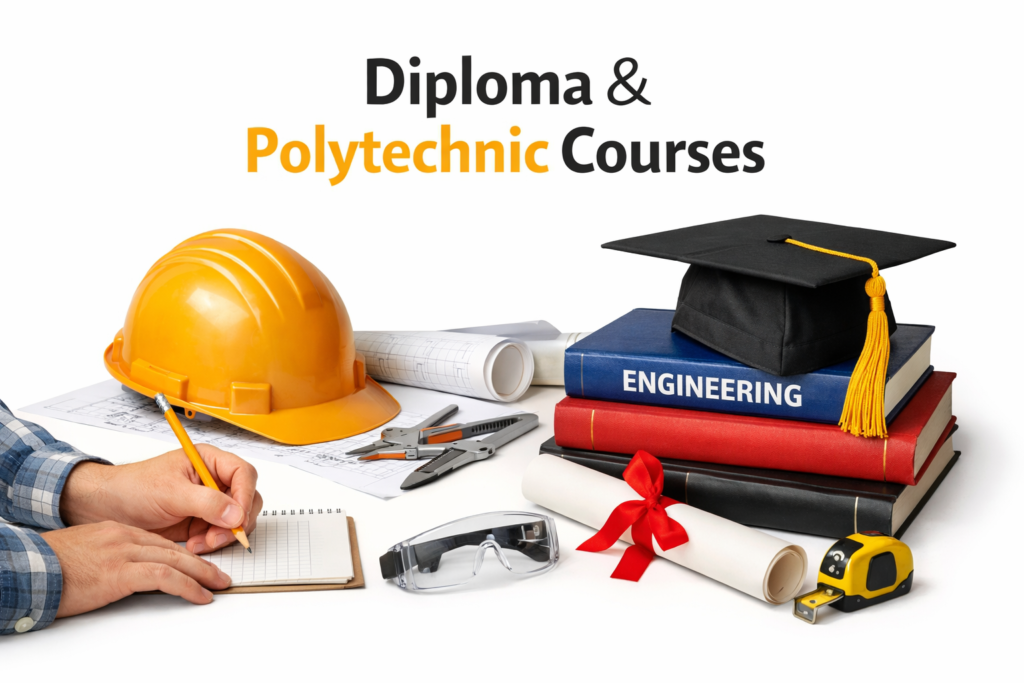
Diploma holders in technical trades are in demand. There’s a massive shortage of skilled technical workers in India, and polytechnic-trained students often find employment faster than their degree-holding peers.
For commerce and arts students, diploma programs in accounting, fashion design, interior design, media, and event management serve the same purpose — skill over credential.
Vocational Courses and Skill Certifications
India’s NSDC (National Skill Development Corporation) funds hundreds of industry-specific training programs. Many of these have no minimum percentage requirement and are available in sectors like healthcare, IT, retail, automotive, and construction.
Private bootcamps in coding, digital marketing, UX design, video editing, and data analytics are another stream entirely. These programs sometimes take 3-6 months and cost far less than a three-year degree. Many of them lead directly to employment or freelance income. Skill based training programs are becoming a popular answer to what to do after 12th with low percentage for students interested in fast career entry.
The honest truth is that in several of these fields, your skill portfolio matters more than your academic history. A 17-year-old who’s done a six-month web development bootcamp and built five client projects is more employable than a 21-year-old with a computer degree and no portfolio.
Courses Available Even With a Low Percentage
Many students researching what to do after 12th with low percentage are surprised to learn how many degree and diploma courses remain accessible.
For science students: BSc in Agriculture, BSc Nursing (check entrance exam eligibility), BSc Hospitality, BSc Fashion Technology, and polytechnic diplomas remain accessible career options after 12th with low percentage.
For commerce students: BBA, B.Com (many private colleges), BMS, BFIA, and diploma programs in accounting and finance don’t require high board scores at colleges accepting low marks.

For arts students: BA in any humanities subject, BJMC (journalism), BA in social work, BPA (performing arts), and BCom have relatively lower cutoffs across India. Arts stream students actually have more doors open than they’re typically told.
Many students also consider admission after 12th without entrance exam in private universities and colleges that offer direct admission based on basic eligibility rather than board exam scores.
| Stream | Best Courses | Duration | Career Options |
|---|---|---|---|
| Science | Polytechnic Diploma, BSc Agriculture, BSc Hospitality | 3 years | Engineering technician, agriculture sector |
| Commerce | BBA, BCom, Accounting Diploma | 3 years | Finance, business management |
| Arts | BA, BJMC, Social Work | 3 years | Media, teaching, government jobs |
| All Streams | Vocational Courses, Skill Certifications | 6–12 months | Skilled jobs, freelancing |
Students exploring different degree options can also check a detailed guide on best courses after 12th with low marks, which explains multiple career paths across science, commerce, and arts streams.
Government Jobs and Competitive Exams — A Parallel Path
This is a path that many students with low marks after 12thcompletely ignore but shouldn’t. Government job preparation — for SSC CHSL, Railway exams, NDA (if eligible), state police constable exams, postal service exams — often requires only 12th pass as the minimum qualification. Percentage isn’t the filter; the entrance test is. For many students exploring what to do after 12th with low percentage, government exams provide a stable and respected career path.
If your boards didn’t go well but you’re willing to prepare seriously for a competitive exam, this route is genuinely viable and leads to stable employment with government benefits.

The discipline it takes to prepare for these exams also becomes a kind of reset — you’re studying on your own terms, building something, moving toward a clear goal.
Entrepreneurship and Self-Employment
This one’s harder to write because it gets misused — people say ‘start a business’ the way they say ‘it’ll be fine,’ as if it means anything concrete. So let’s be specific.
If you have a skill — cooking, photography, repair, teaching, writing, crafting, coding — you can begin building income from it right now. Not after a degree. Now. Platforms like Fiverr, Instagram, YouTube, Meesho, and local markets don’t ask for your 12th percentage.
Some of India’s most successful entrepreneurs didn’t complete their formal education. That’s not inspiration to drop out — it’s just a data point that formal credentials are one path, not the only path. Entrepreneurship is another practical option for students thinking about what to do after 12th with low percentage.
Open University and Distance Education
Distance education is often suggested when students ask what to do after 12th with low percentage but still want a recognised degree. IGNOU, Symbiosis Open University, NMIMS Global, and various state open universities offer degree programs with minimal or no percentage cutoffs. These degrees are valid for government jobs, further studies, and most private sector employment.
Combining distance education with active skill-building or work experience is actually a very strong strategy. You get the credential, you get the experience, and you move faster than the average student sitting in a classroom for three years. What to do after 12th with low percentage often has this hybrid answer at its core.
Students who complete graduation through distance education can later pursue higher studies such as an MBA course in India, which opens opportunities in management, finance, and business leadership roles.
Conclusion
Students searching what to do after 12th with low percentage should understand that multiple career paths remain available. Diploma programs, vocational training, open universities, government exam preparation, and skill-based careers all represent real, sustainable paths. The percentage on your marksheet limits some options, but it doesn’t limit your ability to build a future that’s genuinely yours. Start mapping, start moving, and stop waiting for someone else’s plan to fit your life.
FAQs
1. Which course is best after 12th with a low percentage?
It depends on your stream and interest. Polytechnic diplomas for science students, BBA/B.Com for commerce students, and BA or BJMC for arts students are among the most accessible and career-relevant courses after 12th with low percentage.
2. Can I do a government job after 12th with low marks?
Yes. Many government job exams like SSC CHSL, Railway NTPC, and state police recruitment require only 12th pass — not a minimum percentage. Your performance in the entrance exam determines eligibility.
3. Is IGNOU a good option after 12th with low marks?
IGNOU is a strong option. It has flexible admission criteria, low fees, and a valid UGC-recognised degree. Combined with skill-building, it’s a genuinely practical path for students exploring what to do after 12th with low percentage.
4. Can I do engineering with a low percentage in 12th?
Direct engineering degree (B.Tech) typically requires 45-60% depending on category and institution. Polytechnic diplomas in engineering are more accessible and can lead to the same industry with lateral entry options later.
5. Should I take a gap year if I got low marks in 12th?
A gap year makes sense only if you use it purposefully — for exam preparation, skill development, or specific course preparation. An unstructured gap year without clear goals rarely improves outcomes.