
1. The weight of it
Most people who start researching MBA admission 2026 don’t begin with a spreadsheet. They begin with a feeling. Something shifts — a job that stopped growing, a peer who just got placed at a consulting firm, a parent asking the question again at dinner.
And suddenly you’re on five different websites at midnight trying to figure out whether CAT or XAT or NMAT is the right exam, what the cut-offs are, and whether direct admission is a real thing or a trap.
That overwhelm is almost universal. And in 2026, it’s more acute than it’s been in a long time. The number of CAT applicants has crossed 3.3 lakh in recent cycles. More people are preparing more seriously — the coaching industry is sophisticated, mock test infrastructure is excellent, and the average score at the top percentile bands is higher than it was five years ago.
Getting a 95th percentile used to feel like a safe threshold. At the top ten institutions, a 98 or 99 is a starting point, not a guarantee.
There’s also genuine confusion about what MBA admission 2026 actually means procedurally. India’s system is unusual by global standards. In most countries, you apply directly with a GMAT score and some essays.
Here, you write a national entrance exam, wait for results, get shortlisted by multiple institutions simultaneously, go through group discussions and personal interviews, and end up with a composite score that weighs your academic history, work experience, gender, and background diversity — not just your exam percentile. It rewards people who understand the full system, not just the exam.
There’s also the direct admission question, which deserves a straight answer rather than evasion. Yes, it exists. No, it isn’t always a bad choice. But it comes with trade-offs that need to be understood before you choose that route, not after.
This piece walks through all of it:
MBA Admission 2026 exam, the full timeline, the MBA admission 2026 process stage by stage, eligibility, the MBA Admission 2026 selection process, direct admission, counselling, and honest strategy for different profiles.

2. What is MBA Admission 2026 in India?
The phrase ‘MBA admission 2026’ refers to the admissions cycle that begins with entrance exams in late 2025 and results in students joining two-year MBA Course in June or July 2026 — the 2026-28 batch. When someone says they are ‘appearing for MBA Admission 2026,’
They mean they are writing exams in November-December 2025. CAT 2025 is the exam for MBA admission 2026. The exam year and the admission year are offset by about six months, which trips people up when they’re searching for information.
India’s system differs from most other countries significantly. A GMAT score in the US or UK is a self-reported credential submitted with an application. Here, the entrance exam is a nationally standardised filter — the same paper written by hundreds of thousands of people on the same day. But the exam is the first gate, not the only one.
What makes the Indian system more complex is the composite scoring model used at most serious institutions. Your final admission offer combines your CAT or XAT score with your Class 10 and 12 marks, graduation percentage, work experience, whether you are from a non-engineering background (academic diversity), and whether you are a female candidate (gender diversity).
The exact weights differ by institution. Two candidates with the same percentile can have very different chances at the same institution depending on everything else in their profile.
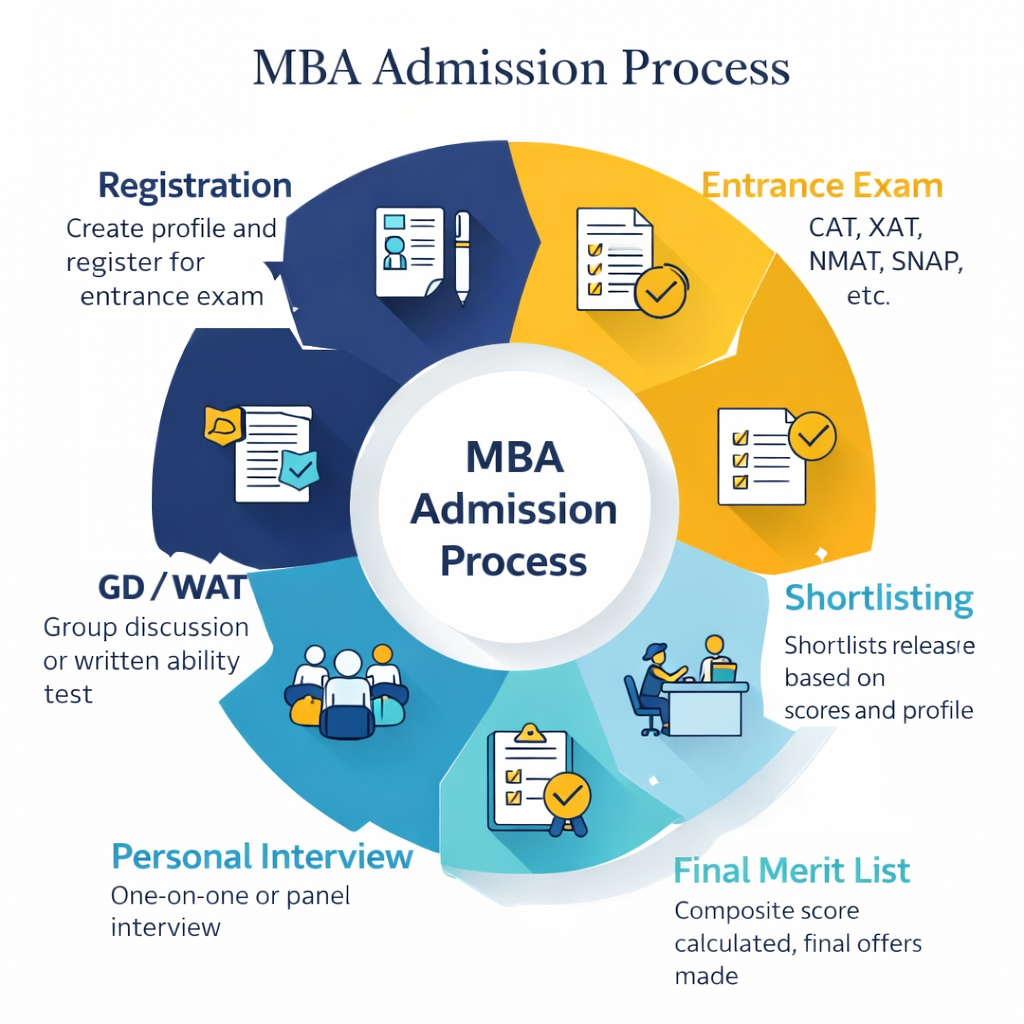
The MBA admission 2026 process, in sequence:
- – Registration: create a profile and register for the entrance exam
- – Entrance exam: appear for CAT, XAT, NMAT, SNAP, or other applicable tests
- – Shortlisting: institutions release shortlists based on exam scores and profile
- – GD / WAT: group discussion or written ability test at shortlisted colleges
- – Personal Interview: one-on-one or panel interview
- – Final merit list: composite score calculated, final offers made
- – Fee confirmation: accept offer, pay seat confirmation fee
Each of those stages can go wrong independently of the others. Which is why people who prepare only for the exam and not for the stages that follow it consistently underperform relative to their scores.
3. MBA Admission 2026- Dates the timeline you actually need
The MBA admission 2026 calendar is predictable in its broad shape, even if specific dates shift slightly from year to year. Here is what the cycle looks like month by month, and what you should be doing at each point.
June to August 2025
This is the registration window for most major exams. CAT registration typically opens in late July or early August. XAT registration opens around August. NMAT registration opens in early August and the testing window begins in October. If you are planning to appear for MBA Eligibility entrance exams 2026, this is when you commit — register, pay the fees, and lock in your exam date where the option exists.
September to October 2025
The pre-exam phase. CAT forms close in September. NMAT testing begins in October. SNAP registration is open through October. This is also the most intensive mock-test period for CAT aspirants — the last six to eight weeks before the exam are when preparation quality either consolidates or falls apart. Most coaching centres run their full-length mocks on weekends during this window.
November to December 2025
The exam window. CAT 2025 happens on the last Sunday of November — this is consistent enough to be reliable for planning. SNAP runs in December, typically in two slots. XAT 2026 is on the first Sunday of January, so preparation for it runs through December. CMAT is also usually administered in January. MAT runs across multiple months and has both online and offline modes.
January 2026
Results season. CAT 2025 results are typically declared in the first or second week of January. NMAT scores are available immediately after each attempt. Shortlists from IIMs and other top institutions begin appearing from mid-January onward. This is also when XAT 2026 is written, so candidates targeting XLRI are still in exam mode while simultaneously tracking CAT shortlists.
February to March 2026
The GD-WAT-PI season. This is the most demanding stretch of the MBA admission 2026 process — candidates may be called for interviews at multiple institutions simultaneously, requiring travel, preparation across different formats, and significant logistical coordination. IIMs typically complete their PI rounds by mid-March. Other institutions run later into April.
April to May 2026
Final offers go out. Most institutions release their final admission lists in April. Candidates have a short window to accept offers, pay seat confirmation fees, and in some cases choose between multiple offers. Waitlists move during this period too.
June to July 2026
Programmes begin. Most full-time MBA batches for 2026-28 start in June or July. Orientation, induction, and the first semester of core subjects.
One practical note: the single most common reason candidates miss out on colleges they were eligible for is missed deadlines. Not low scores. Not bad interviews. Deadlines for application forms, for uploading documents, for accepting offers. The MBA admission 2026 calendar requires active tracking, not passive awareness. Set reminders. Check official websites directly, not third-party aggregators whose information may be outdated.
4. MBA Entrance Exams 2026
There is no single mandatory MBA Admission 2026 entrance exam in India. Different institutions accept different tests, and some candidates write four or five exams in parallel to maximize their options. Understanding what each exam tests, which colleges accept it, and who it suits is the foundation of a sensible exam strategy.
CAT 2025
The Common Admission Test, conducted by the IIMs on rotation, is the gateway to all 21 IIMs and over 1,200 other institutions. Three sections: Verbal Ability and Reading Comprehension, Data Interpretation and Logical Reasoning, and Quantitative Ability. Each is timed separately, total duration two hours. Difficulty is high — DILR in particular is unpredictable year to year. For the top IIMs, 99+ overall with no significant sectional weakness is the threshold. For IIM Lucknow, Kozhikode, or Indore, 96 to 98 with a strong academic profile is typically sufficient.
XAT 2026
The Xavier Aptitude Test, conducted by XLRI Jamshedpur in early January, tests Verbal and Logical Ability, Decision Making, and Quantitative Ability. The Decision Making section is what separates XAT — it presents managerial dilemmas and asks you to evaluate responses rather than solve for a single correct answer. It rewards judgment and nuance. XAT is the primary route to XLRI, SPJIMR, and several other respected institutions. Specific preparation is necessary; CAT prep alone does not transfer fully.
NMAT 2025
The NMAT by GMAC is the gateway to NMIMS Mumbai and partner institutions. The testing window runs October through December, and candidates can attempt it up to three times with the best score counting. No negative marking. Difficulty is moderate compared to CAT. For candidates who want multiple attempts to optimise their score, NMAT is a more forgiving format.
SNAP 2025
The Symbiosis National Aptitude Test is the entry point for all Symbiosis institutes — SIBM Pune, SCMHRD, SIIB. SNAP scores are accepted only within the Symbiosis family. MBA after 3 years experience . If Symbiosis programmes are in your target list, SNAP is non-negotiable. If not, you can skip it entirely.
CMAT 2026
Conducted by NTA, CMAT is one of the most widely accepted tests for Tier-2 and Tier-3 institutions. It tests Quantitative Techniques, Logical Reasoning, Language Comprehension, General Awareness, and Innovation and Entrepreneurship. Difficulty is lower than CAT, and it is accepted by over 1,000 AICTE-approved institutions. For candidates who are not targeting the top twenty institutions and want broad access to credible mid-tier options, CMAT is an efficient exam to write.
MAT and ATMA
Both are primarily used by Tier-2 and Tier-3 B-schools. Lower difficulty than CAT or NMAT. Multiple windows across the year provide flexibility for candidates who missed the main window. Neither opens doors to top-15 institutions, but both provide legitimate options for a broader target list.
Quick comparison
- – CAT: highest difficulty, widest Tier-1 acceptance, no retakes, best for IIM and equivalent targets
- – XAT: high difficulty, unique DM section, best for XLRI and SPJIMR targets
- – NMAT: moderate difficulty, three attempts allowed, best for NMIMS targets
- – SNAP: moderate difficulty, Symbiosis-only acceptance, necessary if SIBM or SCMHRD is in your list
- – CMAT: lower difficulty, broad mid-tier acceptance, efficient for insurance options
- – MAT / ATMA: easiest, primarily Tier-2/3, useful for wide net strategies
5. MBA Admission Eligibility 2026
Final-year graduation students are eligible to apply. This is an important provision because it means you do not need to wait for your results to begin the admission process. If shortlisted and selected, your admission is conditional on producing a final marksheet showing you meet the percentage requirement. Missing this deadline after an offer has been made is a real and avoidable way to lose a seat.
The MBA admission 2026 eligibility criteria are consistent enough across most institutions to be summarised cleanly. A bachelor’s degree from a recognised university in any discipline is the baseline requirement. The minimum percentage is 50% aggregate for general category candidates and 45% for SC, ST, and PWD candidates. These are minimums for appearing in most entrance exams — individual institutions may set higher internal thresholds for shortlisting.
MBA for Working Professionals in IndiaWork experience is not required for full-time two-year MBA program at most institutions, including the IIMs. The exception is ISB Hyderabad’s PGP, which strongly favours candidates with four to five years of experience and makes little accommodation for fresh graduates. Executive MBA programmes across institutions require five to ten years of work experience, and most expect some level of current managerial responsibility.
Academic diversity and gender diversity weightage are worth understanding because they materially affect shortlisting at IIMs and several other top institutions. Candidates from non-engineering academic backgrounds — arts, commerce, science, medicine, law — receive uplift in their composite scores at most IIMs. Female candidates also receive specific weightage, partly to address historical gender imbalances in MBA Admission 2026 classrooms. A commerce graduate or a science graduate with a 97 percentile may have a better chance at certain IIMs than an engineer with the same score, purely on the basis of academic diversity points.

6. MBA Selection Process 2026
The entrance exam gets most of the attention. The selection process that follows it gets proportionally less preparation and causes proportionally more damage to admission outcomes. Understanding each stage is not optional if you want the best result from your scores.
Shortlisting
Once exam results are declared, institutions release shortlists. These are not based purely on your overall percentile. Most serious institutions apply sectional cut-offs as well — you need to cross a minimum threshold in each section, not just in aggregate. A candidate with a 99 overall percentile but a 70 percentile in VARC will be eliminated from institutions with a 80+ sectional cut-off in verbal. This catches a significant number of candidates every year who did very well overall but had a blind spot in one section.
After sectional filters, the composite score kicks in. Your academic profile — Class 10, 12, and graduation marks — is weighted alongside your exam percentile. Work experience adds to the composite at institutions that reward it. Profile diversity components add or reduce. The shortlist you receive reflects all of these factors simultaneously.
GD and WAT
Group Discussions and Written Ability Tests serve different purposes at different institutions. Some IIMs have moved away from GD entirely toward WAT, which is a 20-30 minute essay on a given topic. WAT tests how you structure an argument under time pressure — whether you can identify the core tension in a topic, take a clear position, support it with examples, and acknowledge counter-arguments without losing your thread. GDs, where still used, test something related but different: how you behave in a group, MBA After 2 Years Work Experience whether you can make your point without shutting others down, and whether you’re actually listening or just waiting for your turn. Topics are typically current affairs, business situations, or abstract statements. Preparing by reading widely and forming opinions is more useful than memorising topic-specific arguments.
Personal Interview
The PI is the most underrated part of the MBA admission 2026 process and the stage most candidates systematically underprepare for. Interviewers at IIMs and XLRI have typically been conducting panels for years. They have heard every rehearsed answer. What they are actually looking for is clarity of thought, the ability to sit with ambiguity without getting flustered, and genuine evidence that the candidate has thought seriously about why they want an MBA Admission 2026 and what they plan to do with it.
Standard questions include: walk me through your profile, why MBA, why this institution, where do you want to be in five years, what’s your biggest weakness, and questions about your academic background or work experience specific to your profile. The ‘why MBA’ question is the most important and the most poorly answered. A vague answer about ‘overall development’ or ‘learning management skills’ signals a candidate who hasn’t done the thinking. A specific answer tied to a concrete career goal and a clear articulation of what the degree enables that a candidate cannot achieve otherwise — that’s what good answers look like.
Documents typically required
- – Class 10 and 12 marksheets and certificates
- – All graduation semester marksheets and provisional/final degree certificate
- – Entrance exam scorecard
- – Work experience documents: offer letter, relieving letter, salary slips if applicable
- – Identity proof and passport size photographs
- – Category certificate if applicable (SC/ST/OBC/PWD)
7. Direct MBA Admission 2026
Direct MBA admission 2026 meaning admission without appearing for a national entrance exam — exists, and it is more widespread than the official conversations about MBA Admission 2026 in India suggest. Most private B-schools that are AICTE-approved have a management quota: a percentage of seats, typically 15 to 25%, that are filled outside the merit-based entrance exam route. Some smaller private institutions fill the majority of their seats this way.
Direct admission typically works through an institution-level process. The college conducts its own entrance test, or accepts a combination of any national exam score (even low scores), class marks, and a direct interview. Some institutions are more selective in their direct route than others. A few treat it as a genuine alternative admission track with its own standards. Many do not.
The honest assessment is this: direct MBA admission 2026 is a valid route to a degree, but the trade-offs cluster around placement. Institutions that fill seats through management quota are, with limited exceptions, the same institutions that struggle to attract strong campus recruiters. The recruiters go where the talent pool has been filtered. If the filtering was weak, the talent pool is mixed, and recruiters either don’t come or offer lower packages. That is not universal — some regional institutions with strong local industry ties run decent direct programmes that serve their local markets. But the burden of proof is on the institution.
Before choosing the direct route, run through this checklist:
- – AICTE approval: verify directly on the AICTE website, not through the college’s own claims
- – Placement record: ask for the last three years of placement reports, not just the current year’s headline
- – Median salary: what did the median student get, not the topper
- – Alumni access: speak to actual graduates from the programme, not the ones the college connects you with
- – Faculty profile: check academic credentials and industry experience of core faculty
The risk of direct admission is not just poor placement in the immediate term. It is the brand limitation that follows you for the first ten years of a career, when your degree institution is still the primary signal employers use to filter applications. If the institution name doesn’t register with the recruiters you want to work for, the degree’s value in opening those specific doors is effectively zero — regardless of how much you learned in the classroom.

8. MBA Admission 2026 Counselling Process
For institutions under state-level admission systems — Maharashtra’s MBA-CET, Tamil Nadu’s TANCET, and similar — a formal counselling process determines seat allocation. After your state CET result is declared, you register on a centralised portal, fill in college preferences in order, and are allotted a seat based on your rank and seat availability. The process runs in multiple rounds: Round 1 fills highest-ranked candidates at their first-choice institutions, subsequent rounds accommodate remaining candidates and those who declined earlier offers.
Document verification is mandatory after seat allotment. Missing this step loses the seat. Seat blocking fees — typically Rs 10,000 to Rs 50,000 — are collected at this stage and are partially refundable before a stated withdrawal deadline, with policies varying by state.
Spot rounds fill remaining vacant seats after regular counselling ends. These are announced at short notice and offer access to institutions that seemed unavailable earlier. The most competitive institutions fill in Round 1; spot rounds mostly cover colleges with remaining vacancies.
9. Mistakes to Avoid in MBA Admission 2026
These are not abstract cautionary points. They are the patterns that show up in every admission cycle, with predictable consequences.
Applying to colleges without researching placement records: the college name sounds fine, the website looks professional, but the actual placement data — median salary, recruiter names, sector diversity — tells a different story. This research takes two hours and should happen before the application, not after the offer.
Ignoring ROI: the total cost of the programme, including opportunity cost, divided by the realistic salary jump. If the payback period is seven years at a low-placement institution, that is information that should affect the decision.
Missing sectional cut-offs: scoring 99 overall with 72 in VARC will close more doors than scoring 96 overall with 87 in each section. Most candidates who know about sectional cut-offs still don’t specifically prepare for their weakest section with enough intensity.
Treating the PI as an afterthought: two weeks of half-hearted preparation after a year of exam prep is visible in the room. The interview is where admission is won or lost at the margin, which is exactly where most shortlisted candidates sit.
Choosing a specialisation based on peer consensus or salary rankings rather than personal fit: two years studying something you find genuinely uninteresting is a long time, and it shows in your performance and in your placement conversations.
Not having backup colleges: targeting only top-5 institutions with no clear plan for a different outcome leaves candidates with nothing if that narrow target does not materialise. A well-constructed list has stretch targets, realistic targets, and safe options.MBA College
There is also a more human mistake that deserves naming: making the admission decision entirely based on anxiety rather than analysis. Taking a direct admission at a mediocre institution because the wait for results is unbearable, or accepting the first offer because declining it feels risky — these decisions are understandable emotionally and often costly professionally. The process has structure. Working through it with patience usually produces a better outcome than jumping at the first available exit.

10. MBA Admission 2026 Strategy Based on Profile
Fresh graduates
The main advantage is time flexibility — you can commit fully to exam preparation. The challenge is that your academic profile has to carry more of the composite score, since work experience is zero. Maximise your CAT or XAT percentile and ensure your academic marks are accurately uploaded. In the PI, be concrete about why you want an MBA Admission 2026 now rather than after some work experience. ‘I want to build on my final year project before joining industry’ is more compelling than vague answers about learning management skills.
Working professionals
Work experience adds to your composite score and gives richer PI material. The challenge is preparation time while employed. Most successful working-professional CAT candidates prepare 15 to 20 hours per week for 6 to 8 months. Compressing that into the final two months rarely works. If you have 3 to 5 years of experience, consider ISB and the newer IIMs with PGP-X or PGPEM tracks alongside regular full-time programmes.
Low academic scores
A 60% or 65% in graduation makes shortlisting harder at IIM Ahmedabad, Bangalore, and Calcutta, where academic consistency is heavily weighted. MBA Fees ,It does not close the entire IIM system — IIM Lucknow, Kozhikode, and Indore have different composite weightings. It also does not close FMS Delhi, SPJIMR, MDI Gurgaon, or NMIMS, where the exam score carries relatively more weight. A 99+ CAT with a 60% graduation is still a competitive profile at many institutions worth targeting.
Drop-year candidates
Taking a year to prepare is legitimate and often effective. The thing to prepare for in the PI is an honest, grounded answer about what you did with the time. Interviewers will ask. ‘I spent six months preparing seriously for CAT and worked on X the rest of the time’ is perfectly acceptable if true. Vague deflection tends to read poorly, not because drop years are penalised but because evasiveness is.
11. Is MBA Admission 2026 More Competitive Than Before?
The short answer is yes, in some ways, and no in others. The applicant pool has grown — CAT 2024 had over 3.3 lakh registered candidates, compared to around 2 lakh a decade ago. Coaching has become more sophisticated, which raises the floor at the competitive percentile bands. At the same time, the IIM system expanded from 6 to 21 institutions, and total seat availability at credible programmes has grown significantly.
What has changed most is the shift toward profile-based shortlisting. A high exam percentile is necessary but not sufficient. Academic consistency, work experience quality, intellectual diversity, and interview performance all carry weight. This makes outcomes less predictable from a pure score-chasing perspective — but also means the process is responsive to aspects of a profile that go beyond one exam on one day.
Prepare seriously for the exam. Invest equally seriously in the stages that follow. The candidates who consistently outperform their exam scores in final admissions are the ones who treated the entire process with the same rigour, not just the quantitative section.
12. Last thought
MBA admission 2026 in India is not a lottery. It is a structured, multi-stage process that rewards preparation across the full sequence — exam, profile, GD, PI, college research — and punishes narrow preparation focused on any single stage.
The MBA entrance exams each have their own character. CAT is the widest gate and the hardest to clear at the top. XAT rewards a different kind of thinking. NMAT offers flexibility. SNAP and CMAT serve their institutional ecosystems. Writing the right combination for your target list is more strategic than writing all of them.
The MBA selection process does not end when results are declared. The shortlisting filters, the WAT and GD rounds, the personal interview — that’s where meaningful differentiation happens among candidates sitting near the same percentile. Direct MBA admission 2026 exists and is a real option in specific situations, not a shortcut to the same outcomes as merit-based admission.
Track the MBA admission 2026 carefully. Research your target institutions specifically. Prepare for the interview as seriously as for the exam. The process has structure. Work through it with patience and it will reward you better than anxiety ever will MBA for Working Professionals in India.
Five questions that come up every time
1.When will MBA admission 2026 forms open?
CAT 2025 registration opens in late July or early August 2025. XAT 2026 registration opens around the same time. NMAT registration opens in early August with the testing window starting in October. SNAP registration opens in September. CMAT registration opens in November or December. The specific dates are announced on official exam websites — IIMCAT.ac.in for CAT, xatonline.in for XAT, nmat.org for NMAT. These should be your primary sources, not aggregator websites.
2.Can I get MBA admission 2026 without an entrance exam?
Yes, through the direct admission or management quota route at private institutions. Several private B-schools conduct their own tests or offer admission on the basis of class marks, work experience, and an interview without requiring a national entrance exam score. This is legitimate and AICTE-approved at many institutions. The trade-off, as discussed, is almost always in placement outcomes and institutional brand. For institutions that participate in state counselling, a state CET score is required — but the state CET itself is a different, generally less competitive exam than CAT.
3.What is the minimum percentage required for MBA admission?
The minimum is 50% aggregate in graduation for general category candidates and 45% for SC, ST, and PWD candidates. This is the floor for most entrance exam registrations and for shortlisting by most institutions. A number of strong institutions use internal cut-offs that are higher for shortlisting purposes — IIM Ahmedabad, for instance, weights academic consistency significantly in its composite score, meaning a 55% graduation will put you at a disadvantage even if you cross the technical minimum. Final-year students can apply as long as they fulfill the requirement before the programme starts.
4.Which entrance exam is easiest for MBA admission 2026?
Among the national exams, MAT and ATMA have the lowest difficulty and the most accessible percentile thresholds. CMAT is easier than CAT by a significant margin. NMAT, with no negative marking and multiple attempts, is forgiving in format if not always in content. But ease of the exam and quality of the institutions that accept it are inversely related. CAT is the hardest exam and opens the widest doors. The framing of ‘easiest exam’ is worth questioning — the goal is the right outcome, not the path of least resistance.
5.How many exams should I attempt for MBA admission 2026?
Most serious candidates write two to four exams. CAT is almost always one of them if you are targeting any Tier-1 or Tier-2 institution. Add XAT if XLRI or SPJIMR is in your target list. Add NMAT if NMIMS is a target. Add SNAP if Symbiosis is. CMAT provides broad insurance coverage at lower preparation cost. Writing all six or seven available exams is usually counterproductive — the preparation time is finite and spreading it too thin diminishes quality on the exams that matter most to you. Identify your two or three highest-priority institutions, confirm which exams they require, and anchor your prep around those.